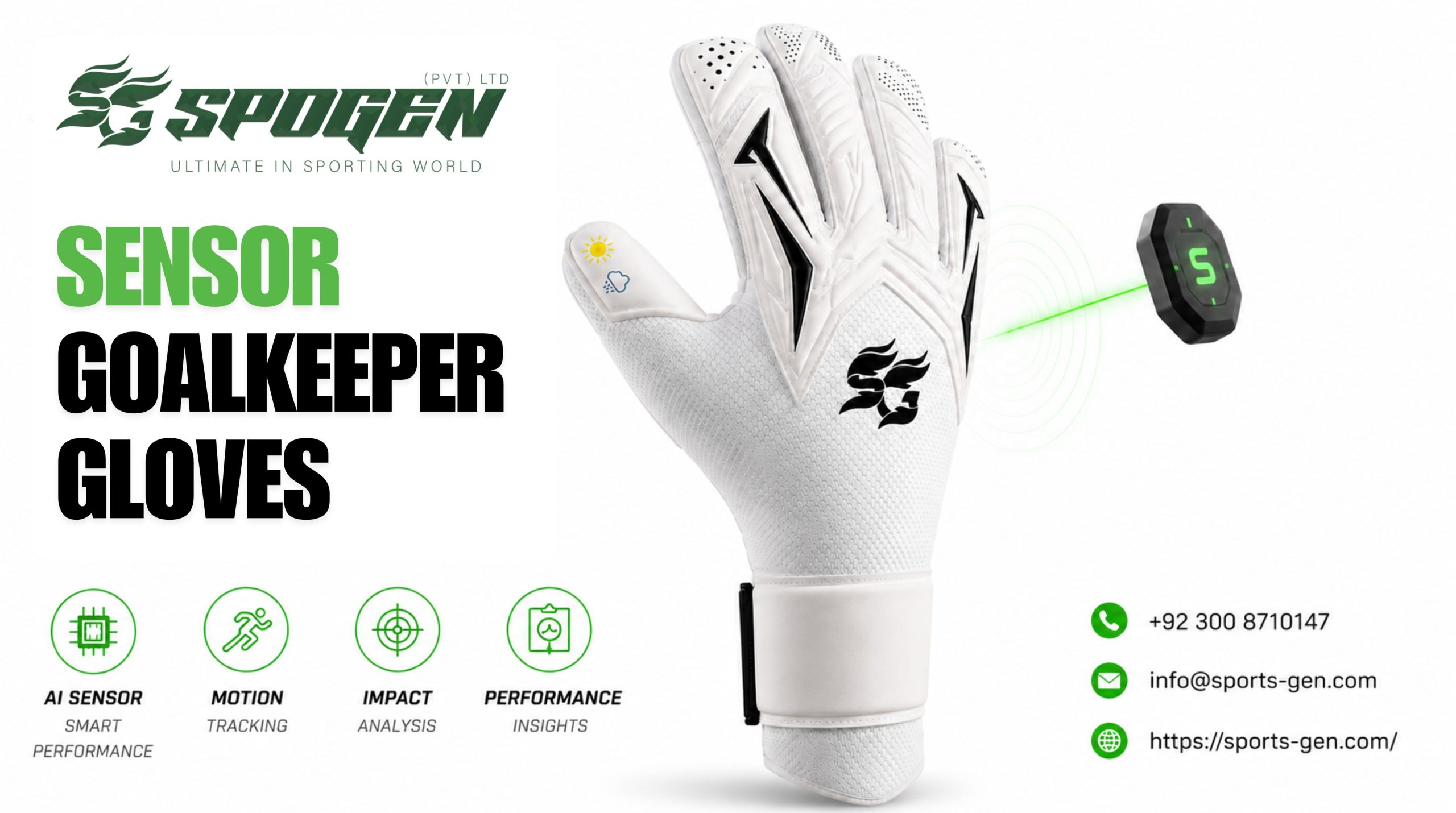
What Are Sensor Goalkeeper Gloves? A Complete Guide to How They Work?
Sensor goalkeeper gloves are training gloves with a small motion sensor built in or attached to them. This sensor tracks how a goalkeeper moves during training, like dives, catches and throws. In this guide, we’ll explain what sensor goalkeeper gloves are, how they work and why more coaches and academies are paying attention to them.
As a B2B sports goods manufacturer that makes goalkeeper gloves every day, SpoGen keeps a close eye on how training technology like this is shaping the way gloves are designed and used, so this guide breaks it down in plain, simple terms.
Table of Contents
What Are Sensor Goalkeeper Gloves?
Sensor goalkeeper gloves are gloves fitted with a small wearable device, usually strapped near the wrist. This device holds two main parts: an accelerometer, which measures movement and speed, and a gyroscope, which measures rotation. Together, these parts record how a goalkeeper’s hand moves through the air during a save.
Think of it like a tiny fitness tracker but built for one very specific job: understanding goalkeeper movement.
Why “Smart” Instead of Just “Padded”
A regular goalkeeper glove is designed to protect the hands and improve grip. A sensor goalkeeper glove does that too, but it also collects data. That data can later be studied to see which exercises a goalkeeper practiced, how many times, and how well.
When Did Sensor Goalkeeper Gloves Start?
The idea of sensor goalkeeper gloves grew out of a research project by computer scientists at the Technical University of Munich. Their study, first shared in 2018 and expanded in 2020, tested a small wearable sensor attached to a goalkeeper’s glove. Researchers wanted to know one thing: could a simple sensor tell the difference between a dive, a catch and a throw, without a human watching? To test this, the team worked with a group of goalkeeper trainees and recorded real training sessions, then used that data to teach a computer system how to recognize each type of movement.
Here’s a quick look at how the early research was built:
- Who was studied: A group of 14 goalkeeper trainees performing real training drills
- What was tracked: Common exercises like dives, catches, throws and jump catches
- How data was collected: A single wearable motion sensor strapped near the glove, not a full-body suit or camera setup
- Where it was published: The findings later appeared in the ACM Transactions on Internet of Things, a respected research journal
- What made it different: Most wearable sensor research at the time focused on general fitness or daily activity, not sport-specific skills like goalkeeping
This research is one of the earliest documented efforts to bring motion-sensing technology into goalkeeper training specifically, rather than general fitness tracking.
Why Were Sensor Goalkeeper Gloves Built?
The reason is simple and honestly, pretty relatable. Many young goalkeepers don’t have access to a personal coach. Professional trainers are expensive and only a small number of goalkeepers, usually older or more advanced ones, get regular one-on-one coaching.
Researchers wanted to build a kind of “virtual coach.” A system that could watch a goalkeeper’s movements through a sensor, understand what exercise was performed and eventually give feedback, even without a trainer standing there.
Goalkeeping is a skill built through repetition. Dives, catches and throws need to become muscle memory. But without feedback, it’s hard to know if practice is actually improving technique. Sensor goalkeeper gloves aim to close that gap by turning training sessions into data that can be reviewed later.
How Do Sensor Goalkeeper Gloves Work?
Here’s the simple version of a fairly clever process. Sensor goalkeeper gloves work in three basic stages: detecting a movement, filtering out unimportant motion and classifying what exercise actually happened.
Detecting a Movement
Every time a goalkeeper catches or blocks a ball, their hand experiences a sudden burst of force. The sensor picks up this burst as a spike in motion data. Special filtering removes slow, everyday movements so only sharp, sudden actions, like impact with a ball or the ground, get picked up.
Filtering Out the Noise
Not every hand movement during training is a real exercise. Goalkeepers also pass balls back to the coach, clap or make small adjustments. A well-designed system learns to recognize and ignore these unimportant movements, so only meaningful exercises get counted.
Classifying the Exercise
Once a real exercise is detected, the system studies the shape of the motion, like how fast the hand moved, in which direction and for how long, to figure out whether it was a dive, a catch, a throw or a jump. In research testing, this classification step reached an accuracy of over 96%, meaning the system correctly identified the exercise almost every time.
How Are Sensor Goalkeeper Gloves Helpful?
The biggest benefit of sensor goalkeeper gloves is turning invisible effort into visible progress. Instead of just remembering “we did a lot of dives today,” a goalkeeper or coach could see exactly how many dives, catches and throws were completed and how they were distributed across a session.
- Objective tracking: Training data isn’t based on memory or guesswork.
- Consistency checks: Coaches can see if a goalkeeper is practicing a balanced mix of exercises.
- Access for everyone: Goalkeepers without a personal coach still get useful training insights.
- Long-term progress tracking: Sessions can be compared over weeks or months.
Current Use of Sensor Goalkeeper Gloves
Right now, sensor goalkeeper gloves are mostly used in sports research and performance labs, rather than being common gear at every local club. Researchers continue studying how to make the sensors more accurate, lighter and more affordable, so the technology can eventually reach everyday training grounds.
The current focus in this field is on identifying training exercises correctly. In research settings, coaches and scientists use the sensor data to build a clear picture of a training session without watching every second of it live. Instead of writing notes by hand or trying to remember which drills were done, the sensor logs each movement automatically, which cuts down on human error and makes it easier to review a session after it’s over.
This kind of tracking is also being used to study how different goalkeepers train compared to each other. By comparing sensor data across several players, researchers can spot patterns, like which exercises get practiced the most or which ones tend to get skipped, information that would be hard to notice just by watching training with the naked eye.
The Future of Sensor Goalkeeper Gloves
Looking ahead, researchers see a few clear directions for this technology:
- Real-time feedback: Instead of reviewing data after training, goalkeepers could get instant feedback during a session.
- Combined technology: Some researchers are exploring how motion sensors could work alongside camera-based tracking for even more detail.
- Wider exercise recognition: Future systems may recognize a broader range of movements, including sprints and warm-up drills, not just core exercises.
- More accessible pricing: As the technology matures, it’s expected to become more affordable for academies and everyday training use, not just research labs.
Sensor Goalkeeper Gloves at a Glance
| Feature | What It Does |
|---|---|
| Accelerometer | Measures the speed and force of hand movement |
| Gyroscope | Measures rotation and direction of movement |
| Exercise Detection | Identifies when a real training movement happens |
| Exercise Classification | Sorts the movement into dive, catch, throw, or jump |
| Main Goal | Give goalkeepers and coaches useful training feedback |
About SpoGen: A B2B Sports Goods Manufacturer
SpoGen PVT LTD is a BSCI and ISO 9001 certified sports goods manufacturer based in Sialkot, Pakistan. We produce goalkeeper gloves, soccer balls, sports apparel and sports bags for clubs, academies, distributors and private label brands around the world. We stay close to research and trends shaping goalkeeper training, like sensor-based technology, because we believe understanding the sport helps us build better gear for the people who play it.
Frequently Asked Questions
Sensor goalkeeper gloves are training gloves fitted with a small motion sensor that tracks a goalkeeper’s movements, like dives, catches, and throws, during a training session.
In research testing, sensor-based systems classified goalkeeper exercises with over 96% accuracy, correctly identifying most dives, catches, throws, and jumps.
Right now, sensor goalkeeper gloves are mostly used in sports research and performance studies. The technology is still developing before it becomes common at everyday clubs and academies.
No. The technology is designed to support training, not replace a coach. It helps track and understand movement, especially for goalkeepers who don’t have regular access to personal coaching.
The main benefit is turning training into measurable data, so goalkeepers and coaches can see real progress instead of relying on memory alone.
Final Thoughts
Sensor goalkeeper gloves are one of the more interesting developments in sports technology, built from a real need: giving every goalkeeper, not just the ones with a personal coach, a way to understand and improve their training. While the technology is still mostly found in research settings today, it points toward a future where training feedback is more precise, more accessible and more useful for goalkeepers at every level.
At SpoGen Sports, we like to stay close to the science behind the sport. Whether it’s how gear is made or how training is measured, understanding the details helps us build better products for the people who use them.
Want to learn more about how goalkeeper gear is built and tested? Get in touch with SpoGen.