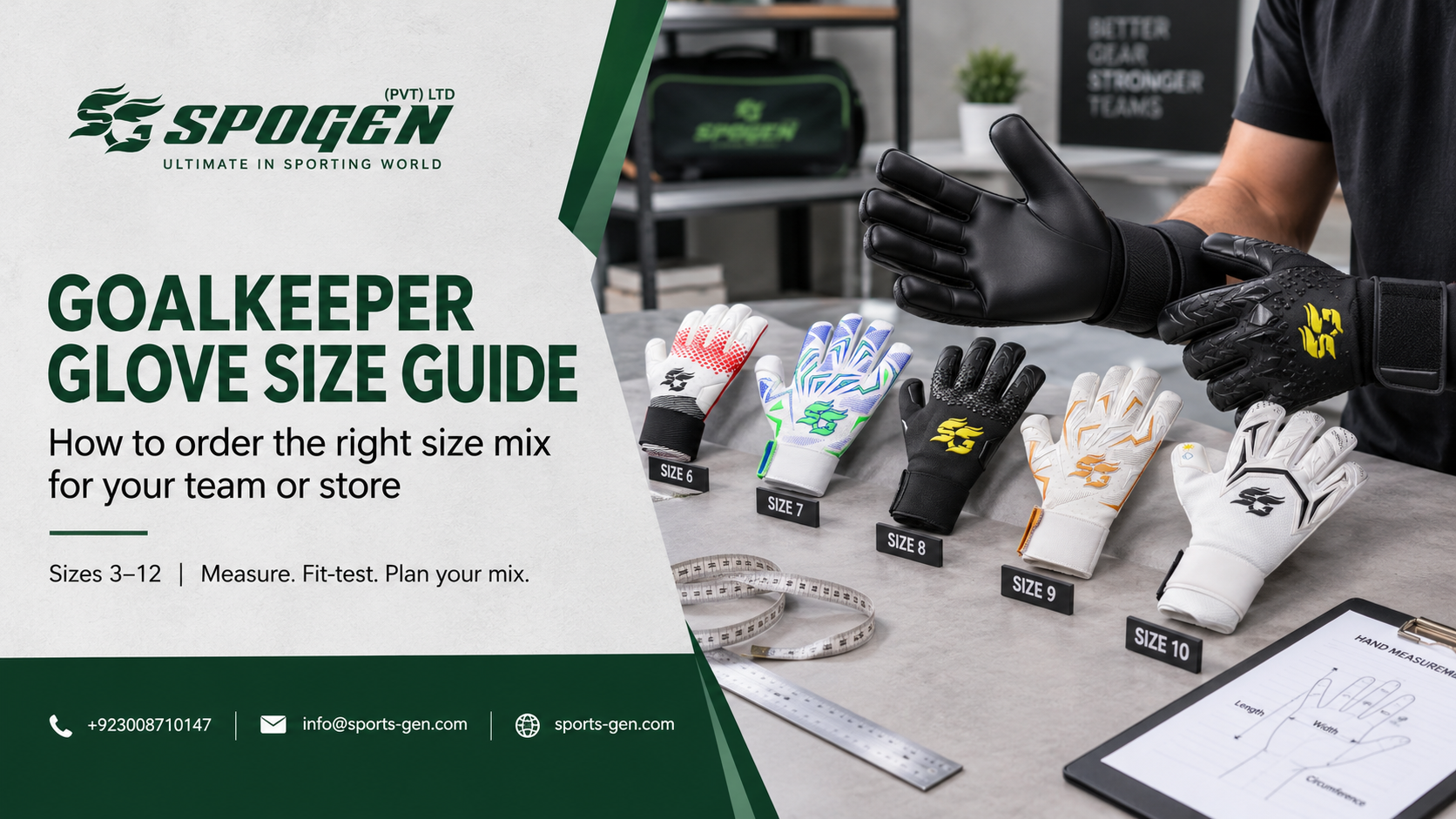
Goalkeeper Gloves Size Guide: How to Order the Right Size Mix for Your Team or Store
Use this goalkeeper gloves size guide to match each keeper’s hand length, width and circumference to a glove size from 3 to 12. Age and height only give a starting point. For bulk orders, plan your size mix from your own sales or player measurements, then fit-test samples.
A wrong glove size is a quiet cost. A pair that is too small or too large can sit on a shelf or come back as a return. A poor size mix can leave some sizes unsold while others run out. We make these gloves in our own factory, so we write this goalkeeper gloves size guide from the production floor. This guide helps you avoid both.
Here you will find how Spogen’s goalkeeper gloves size chart works, a simple way to measure a hand and a clear method to plan your size mix. You will also see how to test samples before you place a bulk order. We make these gloves in our own factory, so we write this guide from the production floor.
It is written first for importers, retailers, distributors, clubs, academies and private label brands. Goalkeepers and parents can use it too.
Table of Contents
Spogen goalkeeper gloves size chart: what it covers
A goalkeeper glove size is the number that matches a keeper’s hand length, hand width and hand circumference. SpoGen’s standard sizes run from 3 to 12.
The Spogen size chart lists each size with its hand length, hand circumference and hand width in centimetres. It also shows a typical age range and an approximate height for each size. We share the full chart with buyers on request.
Request Spogen’s size chart
Send a short message with your buyer type (store, importer, club, academy or private label brand) and the sizes you are considering. We will share the chart and answer your sizing questions
How to read the chart
- Find your glove size in the first column, then read across the row.
- Compare hand length, hand width and hand circumference with that row. All three together decide the size.
- Age and height are only a starting point. Hand measurements decide the size.
- A “~” means about. A “+” means that number or more.
- The chart is a guide to SpoGen’s standard sizes. Each row has its own set of numbers, so do not judge a size from one column alone.
Quick preview: how we measure a hand. You need a ruler, a soft tape and three numbers from each hand: length, width and circumference. Measure both hands, write the numbers down, then match them to a size. The full steps are just below.
How to measure a goalkeeper’s hand
To measure goalkeeper glove size, you need three numbers from each hand: hand length, hand width and hand circumference. Hand length runs from the wrist to the tip of the middle finger. Hand width is the width of the palm. Hand circumference is the distance around the palm. Measure both hands.
Steps to measure a hand
- Get ready: Use a flat table, a ruler and a soft tape. Ask the keeper to open the hand with the palm facing up and the fingers straight and together. The hand should be relaxed, not forced flat.
- Measure hand length: Place the ruler at the wrist crease. Measure to the tip of the middle finger. Write the number down in centimetres.
- Measure hand width: Measure across the palm at its widest point, just below the fingers. Leave the thumb out. Write it down.
- Measure hand circumference: Wrap the soft tape around the palm at the same place, with the thumb outside the tape. Keep it snug, not tight. Write it down.
- Measure the other hand: Hands are not always the same size. Repeat all three steps on the other hand and keep both sets of numbers.
- Match the numbers to the chart: Read across the chart and find the row that is closest for length, width and circumference together. If your numbers sit between two rows, read the FAQ on between-size cases below.
Age and height are a starting point, not the answer
Many buyers ask for gloves by age. Age is easy to know, so it is a handy place to begin. But age does not tell you the size of a hand. Two keepers of the same age can have different hands. Two keepers of the same height can have different hands too. That is why the chart shows age and height as a typical guide only.
Age and height ranges for neighbouring sizes can overlap or meet at the edges. When that happens, the hand measurements decide.
How buyers can use age and height
- Stores and importers: use age and height to set up shelf groups and size labels.
- Clubs and academies: sort players into rough groups first, then measure each hand.
- Private label brands: use age bands to name your youth and adult ranges.
Youth and adult sizes
SpoGen’s chart groups its standard sizes in four bands:
- Sizes 3 to 6: youth
- Sizes 7 and 8: youth–teen
- Size 9: teen–adult
- Sizes 10 to 12: adult
Youth and adult gloves often go to different customers, such as academies and adult clubs. Plan them as separate groups in your order. Then look closely at sizes 7, 8 and 9, because they cover keepers who sit between the youth and adult bands.
If you are building a youth line, see our page on youth goalkeeper gloves manufacturing.
Fit and cut: what changes the feel of a size
Size is only part of how a glove sits on the hand. Cut is the other part. Cut means the way the glove is shaped and built around the palm and fingers.
Cuts Spogen lists
Spogen lists the cuts on its site: negative cut, roll finger, hybrid cut and finger save. Here is what each one means:
- Negative cut: The gloves sit tighter and closer to the hand.
- Roll finger: The latex wraps fully around the finger.
- Hybrid cut: Flat and negative panels are blended in one glove.
- Finger saves: Spogen’s Finger Save Technology, which adds extra finger protection.
Each one is built in its own way, so a glove can feel different from one cut to the next, even at the same size number.
If you are interested in finger protection, see our goalkeeper gloves with finger protection page.
What this means for your size order
- Pick your size from hand measurements first.
- Then check the fit of each cut you plan to order. A negative cut sits closer to the hand, for example, so test it next to another cut at the same size.
- Write the cut next to the size in your order sheet, so the factory and you read the same thing.
How to order the right size mix
A size mix is the number of pairs you order in each size. There is no single right mix for every buyer. Instead of a fixed formula, use the method that matches your business.
Retail store or importer
Your own sales are the best guide. List what you sold last season, size by size. Order your new mix from that list.
If you are new, start with a small spread of sizes across the chart. Watch what sells, then reorder by sell-through. Keep simple records so each reorder is based on facts, not guesses.
Club or academy
Measure each keeper on your roster, using both hands. Group the keepers by age band from the chart. Then confirm each group with the hand measurements. Add a few spare sizes next to the sizes you need, for new players and for between-size cases.
Private label brand
Choose your size range from the chart. You do not need to cover every size from 3 to 12. Decide where your range starts and ends, then plan your size run, which is the full set of sizes in your range. Plan your size marking and labels at the same time, so the spec is complete. See our custom branding for goalkeeper gloves page for branding options.
Planning checklist
- I know which sizes from the chart I want to cover.
- I have sales data by size, or measured hands, or both.
- I have split my youth and adult groups.
- I have chosen the cut or cuts I want.
- I have planned a few spare sizes next to my main sizes.
- I have planned size marking and labels.
- I have a plan to fit-test samples before bulk.
- For a store: I have a plan to reorder by sell-through.
Sample and fit test before you place the bulk order
A chart gets you close. A sample on a real hand confirms it. Follow these steps before you approve bulk production.
- Choose the sizes to sample: Cover your range, and include the sizes next to each other where keepers may sit between two rows.
- Choose the cuts to sample: Sample each cut you plan to order.
- Test on real hands: Measure the keepers first, then try each sample and write down what you see. Take photos.
- Check the size marking: Make sure the size is easy to read and matches your spec.
- Compare the sample with your size spec: Spogen sends a pre-production sample for overseas approval, so you can check colour, sizing, material and branding before bulk production starts. Go through your spec line by line.
- Approve in writing: Send a clear sample approval, including any changes, before bulk production starts.
Once bulk production starts, the factory runs in-line checks at every stage, plus final sampling to AQL standard. Samples, pricing and next steps are confirmed directly with you after the team reviews your requirement.
What to send Spogen for your size spec
A clear size spec saves time for both sides. When you contact us, send these items:
- Size range: the sizes from the chart you want to cover.
- Measurements: the hand length, width and circumference you are working from.
- Size marking: how and where you want the size shown on the glove.
- Packaging: how you want pairs packed and labelled.
- Cut: the cut or cuts you want.
- Branding: logo, colours and any private label needs.
If you already know the style you want, tell us. You can browse our goalkeeper glove range first, then send your requirement to the team using the request box below.
Common sizing mistakes in bulk orders
- Choosing sizes by age alone: Age is a starting point. Hand measurements decide.
- Measuring only one hand: Hands are not always the same size. Measure both.
- Spreading pairs evenly without data: Use your own sales or your own roster to shape the mix.
- Skipping the fit test on a new cut: A size that works in one cut needs checking in another.
- Leaving size marking unclear: If the marking is not agreed in writing, sizes can be mixed up at your end.
- Ignoring the sizes next to your main sizes: Keepers who sit between two rows need a nearby size to try.
Why buyers work with Spogen on sizing
Spogen Pvt Ltd is a factory-direct manufacturer in Sialkot, Pakistan, not a middleman. That means your size questions go to the people who make the gloves. Goalkeeper gloves are our primary focus and we also make soccer balls, sports apparel, sports bags and team uniforms.
Spogen is BSCI, ISO 9001 and ISO 14001 certified. We work on OEM, ODM and private label projects and we serve wholesale buyers, importers, distributors, retailers, sports academies, sports clubs and private label brands in the UK, USA, Canada, Europe, Gulf countries, China and South America.
Frequently Asked Questions
Find the glove size in the first column, then read across that row. Compare hand length, hand width and hand circumference together. Age and height are only a starting point. The hand measurements decide the size, so never pick a size from one column alone.
Measure hand length from the wrist crease to the tip of the middle finger. Measure hand width across the widest part of the palm. Measure circumference around the palm, thumb outside the tape. Do this on both hands, then compare all three numbers with the chart.
SpoGen’s size chart lists a typical age range for each size, from youth sizes at the low end to adult sizes at 10 to 12. Treat age as a starting point only. Two keepers of the same age can have different hands, so confirm each size with hand measurements.
Compare all three measurements: hand length, hand width and hand circumference. Do not choose from one number alone. Then fit-test a sample of both sizes on the keeper’s hand and compare how each one sits. Write down what you see for each size.
The chart shows SpoGen’s standard sizes 3 to 12. For anything else, send your requirement to the team for review. Include the hand measurements and the size range you have in mind, so we can understand what you need and reply with questions.
Start with your own data. A store or importer can use past sales by size. A club or academy can measure each keeper and group them by age band. A new private label brand can start with a small spread of sizes and reorder by sell-through.
In SpoGen’s chart, sizes 3 to 6 are youth, sizes 7 and 8 are youth–teen, size 9 is teen–adult and sizes 10 to 12 are adult. Age ranges overlap in places, so use hand measurements to decide the final size for each keeper.
Yes. A sample on a real hand shows you things a chart cannot. Test each size and each cut you plan to order, check the size marking, and approve the sample in writing before bulk production starts. This step helps you avoid wrong sizes and returns.
Send your size range, target hand measurements, size marking, packaging needs, cut and branding details. Add any sales data by size if you have it. The clearer your size spec is, the easier it is for the team to review your requirement.
Build Your Product Requirement
Not sure about your size range yet? That’s fine. Share what you know about your target buyers, preferred sizes or sales and roster data. Our team will review your requirements and help you identify the right product specifications. Use this goalkeeper gloves size guide to plan your sizes, then send us your requirement.
Get Free B2B Product Guidance & a No-Obligation Quote.