Sportswear Tech Pack: What to Specify Before You Place a Bulk Order
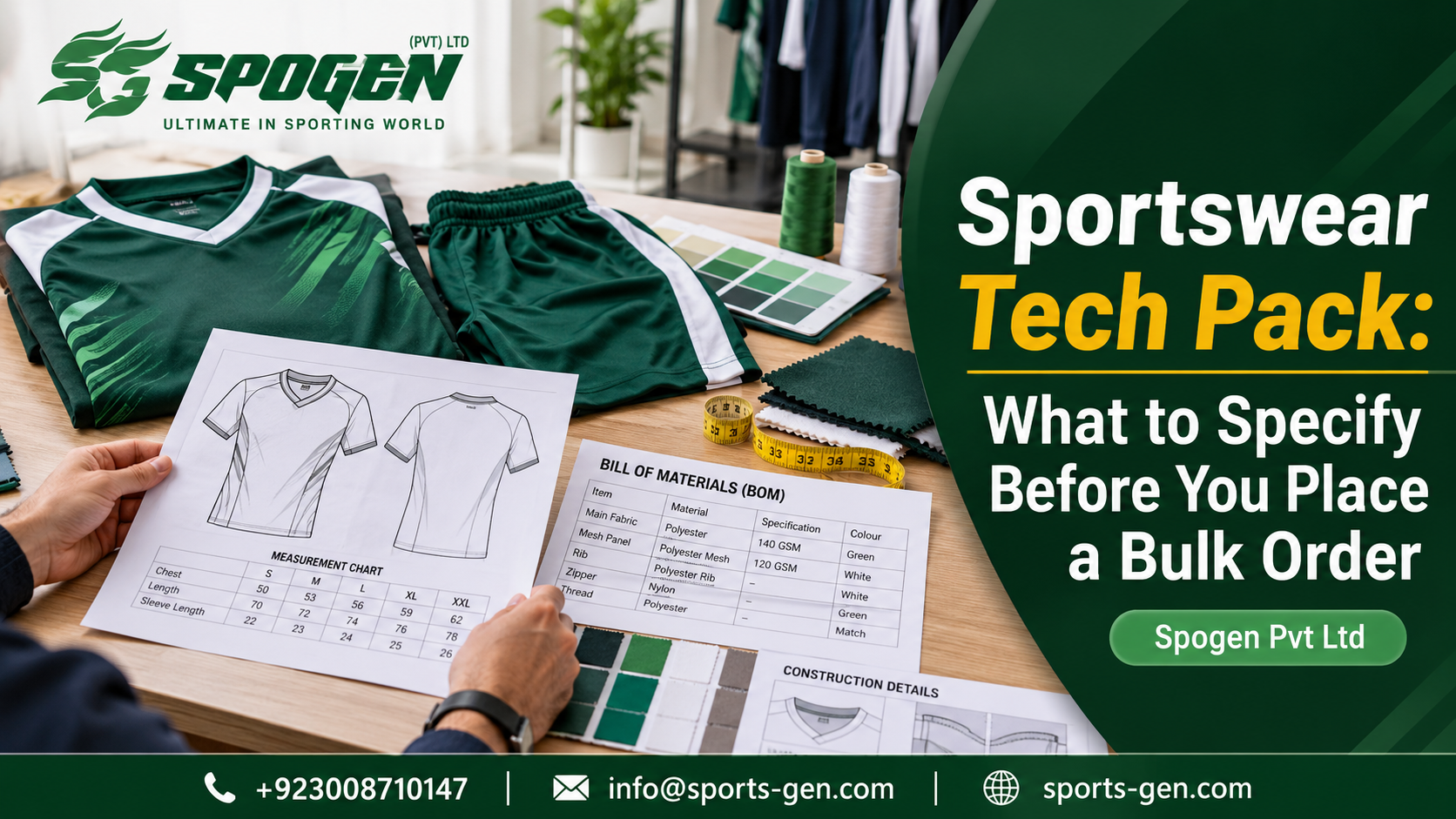
A sportswear tech pack should include a style overview, technical drawings, a bill of materials (BOM), fabric specifications, colorways, a measurement chart with tolerances, construction details, branding and artwork, labels and packaging, testing requirements and a revision history. Approve a pre-production sample against the tech pack before bulk production starts.
Table of Contents
What Is a Sportswear Tech Pack?
A tech pack (short for “technical package”) is a set of specifications for one garment. It is the single reference that you, your designer and the factory all work from. Another common name is a garment tech pack or apparel tech pack.
It is easy to mix up a tech pack with other documents. They do different jobs:
| Document | What it shows | Is it enough to make the garment? |
|---|---|---|
| Design sketch or mockup | How the product should look | No. It has no measurements or materials. |
| Size chart | Body or garment measurements for each size | No. It does not describe fabric, stitching or branding. |
| Tech pack | Look, materials, measurements, construction, branding, labels and packing | Yes, if it is complete. |
| Purchase order | Quantities, prices, delivery and payment terms | No. It refers to the tech pack for product details. |
Think of the tech pack as the “how” and the purchase order as the “how many, how much and when”.
Why Do Sportswear Brands Need a Tech Pack?
Sportswear is judged on details. A jersey that is 2 cm too short, a print that cracks or a fabric that feels different from your sample can all cause returns and unhappy customers. A tech pack helps because it:
- Gives everyone the same reference: Without one, each person fills the gaps with their own assumptions.
- Helps the manufacturer quote more accurately: Fabric, trims, print method, size range and quantity all affect cost. The clearer these are the more reliable the quotation.
- Gives you something to check samples against: If a sample is wrong, you can point to a written specification instead of arguing from memory.
- Supports consistency in bulk: Your approved specification is what the bulk order should match.
- Makes suppliers easier to compare: When you send the same tech pack to several manufacturers, you compare like with like.
A tech pack does not guarantee a faster project or fewer sample rounds. It does reduce guesswork, which is where most problems start.
Different buyers use tech packs in different ways:
| Buyer | Typical starting point | What to focus on first |
|---|---|---|
| Sports brand developing a teamwear collection | Designs and a size range for several styles | A consistent measurement chart, fabric and colour across the whole collection |
| Importer sourcing football jerseys | A reference jersey or a competitor’s product | Fabric weight, print method, size chart for your market and labels |
| Wholesaler building private-label sportswear | A few product ideas and a target price | Clear specifications so quotations are comparable, plus label and packaging details |
| Football club ordering custom uniforms | Club colours, crest and player names | Colour matching, name and number specification, size breakdown per player |
| New sportswear business with only a design reference | A sketch, photos or a sample garment | Starting with a simple brief and building the tech pack step by step |
What Should a Sportswear Tech Pack Include?
You can organise a tech pack into twelve sections. Not every product needs every detail, but this is the full list to work from.
Style Overview
This is the cover page. It identifies the garment so nobody mixes up versions.
- Style name and style number
- Product category (for example, football jersey or training shirt)
- Intended wearer (men, women, youth)
- Fit type (regular, slim or relaxed)
- Size range
- Colorways
- Development stage (first sample, fit sample, pre-production)
- Revision number and date
Technical Drawings
Technical drawings (often called “flats”) are simple line drawings, not fashion illustrations. Include:
- Front and back views, and a side view if needed
- Close-up details for collars, cuffs, pockets or waistbands
- Callouts showing panel lines and stitching
- Placement of zips, vents, panels and mesh sections
A clean drawing should answer a factory’s question without a phone call.
Bill of Materials (BOM)
The BOM lists everything that goes into the garment. It matters because it is the basis for costing, sourcing and keeping production consistent. If a trim is missing from the BOM, it may be missing from the quotation too.
Typical BOM items:
| Item | What to specify |
|---|---|
| Main fabric | Fibre composition, weight, structure, colour |
| Secondary fabrics | Mesh panels, rib trim, contrast panels |
| Lining | Only where used (for example, some jackets) |
| Thread | Type and colour |
| Zips | Type, length, colour, puller style |
| Buttons and snaps | Size, material, colour |
| Elastic and drawcords | Width, colour, finish |
| Labels | Main, care and size labels, and how they are attached |
| Hang tags | Design, material and attachment |
| Packaging | Polybag type, cartons |
Fabric Specifications
“Polyester” alone is not a specification. Two polyester fabrics can feel and perform very differently. Different sportswear products also need different fabric properties, so there is no single GSM that suits every garment. (GSM means grams per square metre, a measure of fabric weight.)
| Property | What to specify | Why it matters |
|---|---|---|
| Fibre composition | For example, polyester or a polyester-elastane blend | Affects feel, stretch and care |
| GSM (weight) | A target value and an agreed tolerance | A heavier fabric is warmer and more opaque; a lighter one is cooler and may be more see-through |
| Knit or woven structure | For example, mesh, interlock, fleece or woven | Affects stretch, breathability and drape |
| Stretch direction | Two-way or four-way, where relevant | Affects fit and movement |
| Stretch and recovery | How far the fabric stretches and returns | Affects shape retention |
| Hand feel | A reference swatch | Words like “soft” mean different things to different people |
| Breathability and moisture management | Your requirement and how it will be checked | Performance claims should be tested, not assumed |
| Finish | For example, brushed or anti-pill | Changes feel and appearance |
| Colour reference | Pantone code or physical swatch | Avoids colour disputes |
| Shrinkage | Maximum acceptable change after washing | Affects fit after the customer washes the garment |
| Pilling | Requirement for fabrics prone to surface fuzzing | Important for fleece, hoodies and tracksuits |
Colorways
A colourway is one colour combination of the same style. To avoid colour surprises:
- Give a Pantone reference and send a physical swatch where you can. Screens show colour differently.
- Ask for a lab dip where fabric is dyed, which is a small dyed swatch for your approval.
- For printed designs, ask for a strike-off, which is a printed sample of the artwork on the actual fabric.
- Check that panels and components (for example, collar rib and main body) match each other.
Measurement Chart
The measurement chart lists the garment’s size at each point of measurement (POM). For each point, include:
- The name (for example, chest width, body length, shoulder width, sleeve length, hem width)
- Clear instructions on where and how to measure it
- The measurement for your base size
- Measurements for the full size range
- Units (cm or inches and which one is the master)
- A tolerance, the allowed difference from the target (for example, plus or minus a set number of centimetres)
- A diagram showing each point
A size label like “Men’s M” is not a measurement. Sizes vary by market and by brand, so always give numbers.
Size Grading
Grading means how measurements change from one size to the next. For example, the chest might grow by the same amount between each size, while the sleeve length grows by a smaller amount. Grading rules keep the fit proportionate across your range.
If you do not provide grading rules, the factory may apply its own. State your rules or reference sizes if the fit across the range matters to you. See the illustrative example later in this guide.
Construction Details
This section describes how the garment is put together. It may include:
- Seam types and stitch types
- Seam allowance
- Hem and cuff finishing
- Reinforcement at stress points (for example, shoulder or crotch seams)
- How panels are joined
- Neckline and collar construction
- Any special requirements for stretch fabrics
Ask the factory to confirm which stitches and machines suit your fabric.
Branding and Artwork
State how each logo or graphic is applied and exactly where it goes.
| Method | Common use | What to specify |
|---|---|---|
| Sublimation printing | Full-colour designs on polyester fabrics | Artwork file, colour references, print area |
| Screen printing | Solid-colour logos and numbers | Colours, ink type, size |
| Heat transfer | Names, numbers and small logos | Material, size, position |
| Embroidery | Crests and logos on thicker fabrics | Stitch count or size, thread colour, backing |
Also include:
- Logo size and position, measured from a fixed point (for example, “6 cm below the neck seam”)
- Artwork file format and colour mode
- Name and number fonts, sizes and positions for teamwear
- Any sponsor logos and who approves them
Labels and Packaging
- Main label: brand name and logo
- Care label: washing and care instructions
- Size label
- Country-of-origin marking, where required
- Hang tags
- Polybags, folding method and carton details
- Barcodes and carton marking, if your retailer or warehouse requires them
Labelling rules depend on the country where you sell, so check the requirements for your destination market before you finalise the labels. For care instructions, ISO 3758:2023 describes a code of care symbols for washing, bleaching, drying and ironing. Some markets use their own systems, so confirm which one applies to you.
Revision History
Tech packs change. A revision log records:
- Version number and date
- What changed
- Your comments on each sample
- Which version is approved
- Which version is the final production reference
Without this, it is easy for a factory to build from an old version.
Example: A Simplified Tech Pack for a Football Jersey
Important: Everything in this section is a fictional, illustrative example. These are not SpoGen’s specifications, standard sizes or tolerances.
Style overview (example)
| Field | Example entry |
|---|---|
| Style number | SG-001 (example) |
| Description | Short-sleeve performance football jersey with mesh side panels |
| Fit | Regular fit |
| Intended wearer | Adult men |
| Fabric | 100% polyester knit (example) |
| Weight | 140 GSM (example value only, to be confirmed with your supplier) |
| Colourway | Navy body, white trim (Pantone references to be added) |
| Branding | Sublimated front design, heat-transfer back name and number, club crest |
| Size range | S, M, L, XL |
| Revision | Rev 01 |
Bill of materials (example)
| Item | Example specification | Used on |
|---|---|---|
| Main fabric | 100% polyester knit, 140 GSM, navy | Body and sleeves |
| Side panel | Polyester mesh, navy | Side seams |
| Collar trim | Polyester rib, white | Neckline |
| Thread | Polyester, matched to fabric colour | All seams |
| Main label | Heat-transfer neck label | Inside back neck |
| Care label | Printed, with symbols | Inside left side seam |
| Size label | Printed | Inside back neck |
| Packaging | One garment per polybag | Each unit |
Measurement chart (example, in cm, flat measurement)
| Point of measurement | S | M | L | XL | Tolerance (example) |
|---|---|---|---|---|---|
| Chest width (2.5 cm below armhole, flat) | 51 | 54 | 57 | 60 | ±1 |
| Body length (from high point of shoulder) | 70 | 72 | 74 | 76 | ±1 |
| Shoulder width | 44 | 46 | 48 | 50 | ±0.5 |
| Sleeve length | 22 | 23 | 24 | 25 | ±0.5 |
Grading in this example: chest +3 cm per size, body length +2 cm, shoulder +2 cm, sleeve +1 cm. A real chart would have many more points and the numbers depend on your fit and market.
Construction, labels and packing notes (example)
- Join shoulders and side seams with a stretch-suitable seam. Reinforce the shoulder seams.
- Finish the hem with a flat, comfortable stitch that does not pull on the fabric.
- Attach the collar trim so it lies flat and keeps its shape after washing.
- Place the club crest 8 cm below the left shoulder seam (example measurement).
- Fold and pack each garment in a single polybag, with the size visible on the bag.
What each part tells the factory
| Specification | What it tells the factory |
|---|---|
| Fabric and GSM | What to source and what the sample should feel like |
| Colourway | What colour to match |
| Measurement chart and tolerances | What size each point should be, and how much variation is acceptable |
| Construction notes | How to stitch and finish the garment |
| Branding placement | Where to apply each logo, name and number |
| Label and packing notes | How to finish and pack the product |
How to Prepare a Tech Pack for Different Sportswear Products
Different garments need attention in different places. Use this as a guide to what to specify first.
| Product | Pay particular attention to |
|---|---|
| Football jerseys | Breathability and stretch, mesh panel placement, print method and colour match, collar construction, name and number placement |
| Training shirts | Fabric weight and moisture management, seam comfort, fit across the size range |
| Sports shorts | Waistband and elastic, drawcord, inseam length, pocket details, whether there is an inner lining |
| Tracksuits | Matching jacket and trouser fit, zip type and length, cuffs and hems, fabric finish, pilling and shrinkage |
| Sports jackets | Zip quality, lining, pocket construction, whether any water-resistance claim is tested |
| Hoodies and sweatshirts | Fabric weight and finish, hood shape and construction, rib trims, pilling and shrinkage |
What If You Don’t Have a Tech Pack?
You do not need a professionally prepared tech pack before you contact a manufacturer. Many buyers start with something simpler:
- A hand-drawn sketch
- A reference garment
- Product photographs
- A digital mockup
- A written product description
- Your preferred fabric and branding ideas
A manufacturer will usually need to clarify a few things before developing a sample:
- What the product is and who will wear it
- The size range and target market
- The fabric you want or the look and feel you are aiming for
- The branding method and artwork
- Estimated order quantity
- Packaging and labelling needs
You can often get an indicative quotation from this information, which the manufacturer then refines once fabric, trims and branding are confirmed. Whether and how a given factory helps develop the tech pack depends on that factory.
How Does the Sportswear Sampling Process Work?
Sampling usually moves through several stages. The exact names and number of rounds vary by factory and by product.
| Stage | Purpose | What you check |
|---|---|---|
| Prototype or first sample | Test the design, construction and look | Shape, fabric feel, branding placement, general construction |
| Fit sample | Test measurements and fit | Measurements against the chart, fit on a model or player |
| Revised sample (if needed) | Confirm that your comments were applied | Every point you raised on the previous sample |
| Pre-production sample | Final approval before bulk | Intended fabric, trims, construction, artwork and labels |
Two extra checks often happen before or alongside these stages: the lab dip (color) and the strike-off (print on fabric).
The pre-production sample should represent the approved production specification as closely as possible. That means the fabric, trims, construction, artwork and labels you expect in the bulk order.
Use a written approval process
- Send your comments on each sample in writing, point by point, with photos and measurements.
- Ask the factory to confirm in writing how each comment will be handled.
- Update the tech pack and record the new revision.
- Approve the pre-production sample in writing, naming the tech pack revision.
- Keep one approved sample as your reference.
Handling changes after approval
Changes after approval (for example, a different fabric lot, a new label or a moved logo) can affect cost, timing and consistency. Agree in advance that any change to the approved specification must be confirmed in writing by both sides before it is made.
What Should You Check Before Approving a Pre-Production Sample?
Check the sample against your tech pack, not just against how it looks:
- Measurements: Measure every point on your chart and compare with the tolerance.
- Fabric: Check fibre composition, weight and feel against your specification and swatch.
- Color: Check in daylight as well as on screen. Compare panels with each other.
- Print and embroidery: Check position, size, edges, cracking, bleeding and colour.
- Stitching and finishing: Look for straight seams, secure ends, skipped stitches, puckering and loose threads.
- Trims: Check zips, elastic, drawcords and buttons for correct type, color and function.
- Labels: Check position, content, spelling and attachment.
- Fit: Try the sample on a person, not only on a table.
- Wash result: If you requested a wash test, check shrinkage, colour change and print condition.
- Packaging: Check folding, polybag, hang tag and size marking.
What Should You Confirm Before Bulk Production?
Before you release the order, make sure the following are agreed and written down:
- The approved pre-production sample and the final tech pack revision
- Quantities by style, size and colour
- Final fabric and trim sources, so bulk matches the sample
- Branding artwork and placement
- Labels and packaging details
- Required tests and who pays for them
- The inspection plan: when inspections happen, who does them, and what standard is used
- Delivery date and shipping method
- How changes will be handled after approval
For inspection, many buyers use an Acceptance Quality Limit (AQL) approach. ISO 2859-1 is the international standard for AQL-based sampling inspection and its third edition was published in January 2026. Agree the AQL level, defect classes and inspection stage with your supplier before production begins. Do not assume a default.
Common Sportswear Tech Pack Mistakes to Avoid
- Vague fabric descriptions: “Soft polyester” can mean many things. Give composition, weight and a swatch.
- Size labels instead of measurements: Always include a measurement chart.
- No tolerances: Without them, nobody knows what counts as acceptable.
- Unclear logo placement: Use measurements from fixed points, not “near the chest”.
- Relying on screen colours: Use Pantone references and physical swatches.
- Missing trims and labels: If it is not in the BOM, it may not be in the quote.
- Skipping care label and labelling rules: Requirements depend on your destination market.
- Changing the design after sample approval: This can affect cost and timing.
- Treating a test method as a pass: A method names how to test; only a report shows the result.
- Using an old revision: Keep a clear revision history.
How Spogen Supports Custom Sportswear Development?
Spogen Pvt Ltd is a B2B sports goods manufacturer based in Sialkot, Pakistan. It works with sports brands, importers, wholesalers, distributors, retailers, clubs and academies. The business model is factory-direct and covers OEM, ODM and private-label manufacturing, including custom sportswear and teamwear. You can see the current apparel range on the custom sports apparel manufacturer page.
Spogen is BSCI, ISO 9001 and ISO 14001 certified. These certifications relate to the company’s social compliance and management systems. They are not test reports for any individual garment, so you should still agree on product testing for your own order.
FAQs about Sportswear Tech Pack
A sportswear tech pack is a technical document that tells a manufacturer how to make a garment. It includes drawings, materials, measurements, construction notes, branding details, labels and packaging.
At minimum: the product type, a design or reference, fabric preference, size range, branding requirements, estimated quantity, packaging needs and target market. A full tech pack adds measurements, a bill of materials and construction details.
Often yes. You can start with a sketch, reference garment or photos, and the factory can ask questions to fill the gaps. The more you define, the more accurate the sample and quotation will be. Check with your chosen manufacturer what support it offers.
A size chart lists measurements for each size. A tech pack includes the size chart plus drawings, materials, construction, branding, labels and packaging.
BOM stands for bill of materials. It lists every fabric, trim, label and packaging item used in a garment, with its specification. It is used for costing, sourcing and keeping production consistent.
Points of measurement (POM) are the specific places on a garment that are measured, such as chest width, body length, shoulder width and sleeve length. Each has a target size and a tolerance.
Size grading is how the measurements change from one size to the next. Grading rules keep the garment’s proportions consistent across your size range.
A pre-production sample is the final sample made to show what the bulk order will look like. It should use the intended fabric, trims, construction, artwork and labels. You approve it in writing before bulk production starts.
Approve the pre-production sample, the final tech pack revision, quantities by size and colour, labels, packaging, testing requirements, the inspection plan and delivery terms. Record them in writing.
Many manufacturers like Spogen offer OEM, ODM or private-label development. The level of support differs by factory, so ask what is included, such as design help, pattern making, sampling and tech pack preparation.
Build Your Product Requirement
Planning a custom sportswear collection?
Share your product idea, design or reference, fabric preference, branding requirements, size range, estimated quantity and target market. Our team can review your requirements and discuss the next steps.