Goalkeeper Glove Cuts Explained | A Buyer’s Guide to Negative, Roll Finger, Flat and Hybrid Cuts
A goalkeeper glove can have a great palm and still feel wrong on the hand. Very often the reason is the cut.
If you plan a glove collection, buy gloves in bulk or build a private label range, you need to know what each cut really is. You also need to know what to write in your spec and what to check in a sample. This guide explains all of that in plain words.
We write it from the factory side. Spogen is a factory-direct goalkeeper glove manufacturer in Sialkot, Pakistan. We make gloves for other brands and businesses.
Table of Contents
What are goalkeeper glove cuts?
A goalkeeper glove cut is the way the palm and backhand are shaped and sewn around the fingers. It decides where the seams sit, how much room the fingers get and how far the latex wraps around them.
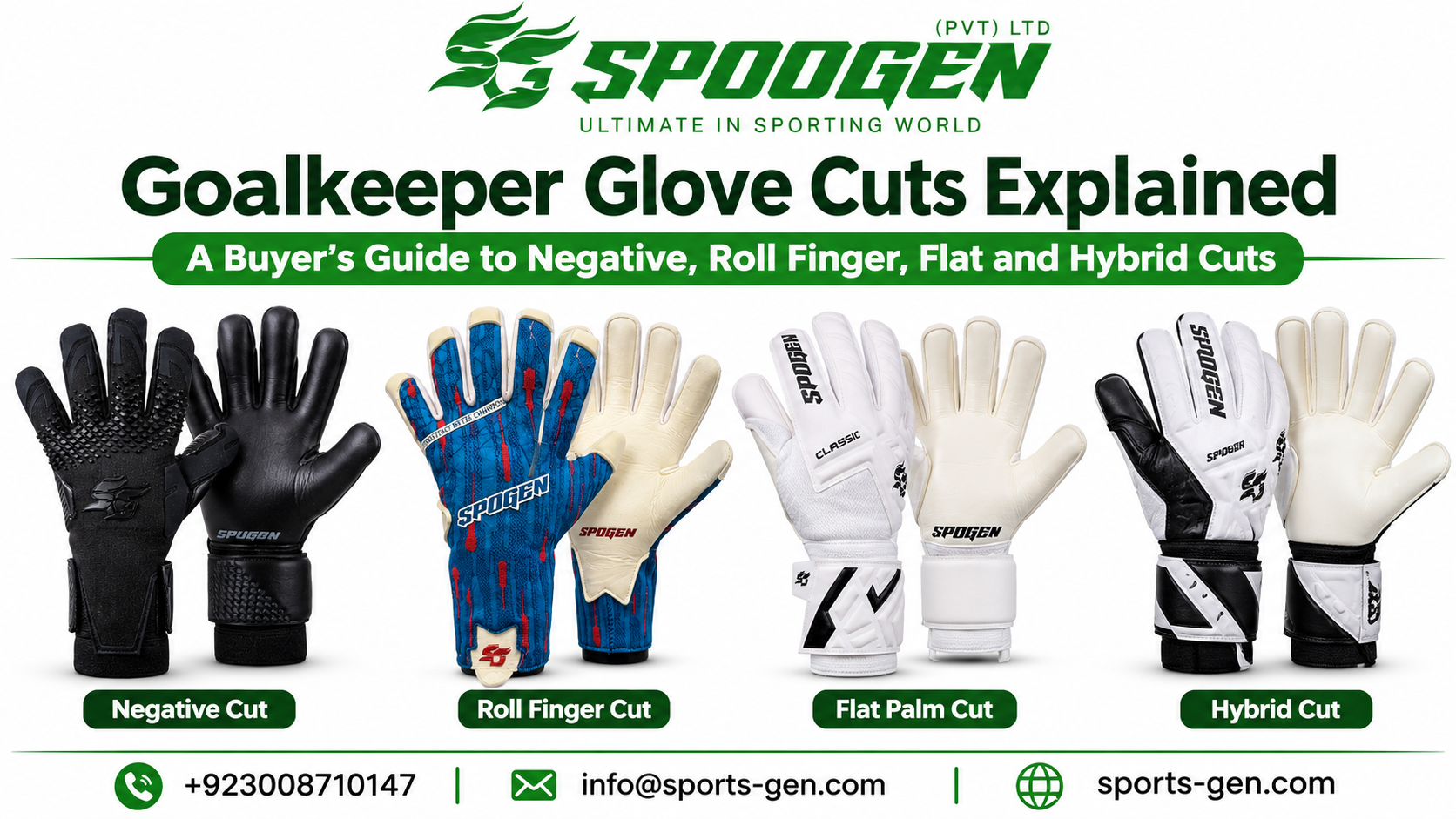
The four main cuts are:
- Negative cut: seams on the inside. Usually the closest fit.
- Roll finger cut: the palm latex wraps around the fingers. Usually, the most latex on the ball.
- Flat palm (positive) cut: seams on the outside, with a flat palm. Usually the most finger room.
- Hybrid cut: a mix of two or more of the above. The mix is different from brand to brand.
No cut is best for everyone. Hand shape, fit taste, size and the exact glove pattern all matter.
Why glove cut changes fit and ball contact?
The cut changes three things you can feel straight away.
- Space around the fingers: Less material means a closer, “second skin” feel. More material means more room.
- Where the seams sit: Inside seams hide the stitching. Outside seams sit on the glove edge.
- How the latex meets the ball: Some cuts wrap latex round the finger. Others use a flat palm with panels between the fingers.
Some glove makers say that a closer cut gives a more direct feel for the ball, while a wider cut gives a bigger catching surface. Treat that as a general idea, not a rule. Real gloves vary.
Cut is not size, grip or finger protection
Buyers often mix these up. Keep them apart in your spec.
| Feature | What it means |
|---|---|
| Size | The number that matches hand length, width and circumference. See our goalkeeper gloves size guide. |
| Cut | How the palm, backhand and finger panels are built and sewn. |
| Palm latex | The foam and latex on the palm. |
| Grip technology | The latex mix and surface. It is about how well the palm holds the ball. |
| Finger protection | Finger spines or similar parts that help limit backward bending. Read more in our guide to goalkeeper gloves with finger protection. |
| Backhand construction | The material and layers on the back of the hand. |
| Wrist closure | The strap, cuff or bandage. |
Finger-save is not a cut. It is a finger protection feature. A negative cut glove, a roll finger glove or a flat glove can each be made with or without finger protection.
Also, cut alone does not decide grip. Latex type, latex condition and care matter too.
The four main goalkeeper glove cuts
Negative cut
What it is: A negative cut glove is sewn with the seams on the inside. The panels that make the fingers are joined from the inside, so there is less loose material around each finger.
How it is built: Maker descriptions say the palm and backhand are stitched together on the inside, often with small side panels (gussets and sidewalls) between them. That is why the outside looks smooth.
Fit and feel: It usually sits close to the hand. Many keepers describe it as a second skin. The fingers feel the ball more directly.
Who may prefer it: Keepers who like a snug glove and a close feel. It may suit slim fingers, but that is not a rule. Some makers also offer extra-tight versions for small hands.
Benefits.
- Close fit and direct feel.
- Neat look with no outside seams on the fingers.
Limits.
- A very close fit can feel tight on thick or wide fingers.
- Some makers note that tight finger spacing can reduce the latex that touches the ball.
What a manufacturer must watch: The pattern has to be exact because there is little spare material. Inside seams must be neat so they do not rub. Finger length and width need to stay the same from size to size.
Roll finger cut
What it is: In a roll finger glove, the palm latex wraps around the fingers. There are no gussets between the fingers on the palm side.
How it differs from negative cut: Negative cut joins palm and backhand on the inside. Roll finger covers the finger with one wrapped piece of latex, so there is more latex around the finger.
Fit and feel: This is where makers disagree. One big brand says roll finger feels roomier. Another source says it feels tighter. The honest answer is that it depends on the pattern. Always test a sample.
Latex coverage: Makers describe roll finger as giving the largest latex-to-ball area of the main cuts.
Who may prefer it: Keepers who want lots of latex on the ball and do not want a tight second-skin to feel.
Benefits.
- Large catching area.
- Smooth latex wrap with no seam on the finger surface.
Limits.
- More latex around the fingers can change how the glove bends.
- Fit varies a lot by brand and pattern.
What a buyer should check before choosing it. How far the latex wraps. How the glove bends at the finger joints. Whether the fit matches your target keepers. Ask for a photo of the finger layout in the sample.
Flat palm (positive) cut
What it is: The flat palm cut is the traditional style. The palm is a flat piece of latex. The backhand is joined to it with strips of material between the fingers.
Why “positive”? Some trade lists use “positive” for outside seams, as the opposite of “negative”. The names flat, regular and positive are often used for the same idea, but not always.
How it is built: The seams sit on the outside. The finger gussets (the strips between the fingers) adds width. This is why the glove has more finger room.
How it differs from negative cut: Negative cut hides the seams inside for a closer fit. Flat cut puts them outside for more space.
Who may prefer it: Keepers who like a roomier glove. Some makers also say the flat palm forms a wide, almost continuous surface when the fingers are together.
Benefits.
- More finger space.
- Wide palm surface.
Limits.
- Less “bare hand” feel than a close cut.
- Outside seams need good finishing.
What a manufacturer must watch. Seam finish on the outside, gusset width, and keeping the palm flat and even across sizes.
Hybrid cut
What it is: A hybrid glove mixes two or more constructions in one glove. For example, some fingers can be negative and others can be rolled.
Why makers mix cuts: To get the good points of each. A designer may want a close fit in the middle and more latex on the outer fingers.
Important: hybrid does not mean one fixed design. Brand documents show many different mixes:
| Example source | What “hybrid” means there |
|---|---|
| uhlsport (HYBD) | Combines Half Negative comfort with a Finger Surround latex wrap. |
| Reusch (Hybrid Negative) | Negative construction with one gusset and latex wrapped around the index and little fingers. |
| Kipsta / Decathlon (F900) | Combines negative and flat stitching across the fingers. |
| The One Glove (Hyla®) | Combines a flat finger base with stitchless roll fingers. |
| Other hybrid designs | May combine negative, flat and roll finger constructions in different ways. For example, negative construction on the middle fingers and rolled construction on the outer fingers. |
So “hybrid” tells you very little by itself.
Benefits.
- Can balance fit, finger space and latex coverage.
- Lets a brand build its own look and feel.
Limits.
- Harder to compare between brands.
- More panels mean more steps to get right in production.
What a buyer should check in a hybrid sample. Ask for a finger map. This is a simple drawing or photo that says which cut each finger uses. Check the sample against it.
Goalkeeper glove cuts compared
The tables below are general guides. Real gloves vary by pattern.
How they are built
| Cut | Basic construction | Seam position | Typical fit | Finger space | Feel and latex coverage |
|---|---|---|---|---|---|
| Negative | Palm and backhand joined from the inside, often with small side panels | Inside | Close, snug | Least | Direct feel. Latex coverage depends on the pattern |
| Roll finger | Latex wraps round the finger, no palm-side gussets | Mostly outside edges | Varies by brand | Varies | Largest latex-to-ball area |
| Flat (positive) | Flat palm with strips between the fingers | Outside | Roomier | Most | Wide palm surface, less close feel |
| Hybrid | Two or more builds mixed | Mixed | Depends on the mix | Depends on the mix | Depends on the mix |
Who may like it and what to plan
| Cut | Goalkeeper profile that may prefer it | Main benefits | Possible limits | Range considerations for B2B buyers |
|---|---|---|---|---|
| Negative | Likes a snug glove and close feel; some slim-finger keepers | Close fit, direct feel, neat look | Can feel tight on wide or thick fingers | Offer clear sizing advice. Fit-test across sizes |
| Roll finger | Wants lots of latex on the ball; likes a less tight feel | Large catching area | Fit varies a lot by pattern | Agree the exact wrap and fit in a sample |
| Flat (positive) | Likes a roomier glove | More finger space, wide palm | Less close feel | Check outside seam finish. Useful as a roomier option in a range |
| Hybrid | Has tried other cuts and wants a mix | Can balance fit and coverage | Hard to compare. More panels to make | Always write the finger map into the spec |
These cuts are not ranked. The best one is the one that fits your target keeper and your product plan.
Which cut may suit different hand shapes and fit preferences?
Here are straight answers to the questions buyers ask most.
- Which cut gives the closest fit? Negative cut, in most patterns.
- Which gives the roomiest fit? Flat cut, in most patterns.
- Which wraps latex round the fingers? Roll finger.
- Which combines different builds? Hybrid.
- Which may suit narrow fingers? A negative or tighter build may suit them. Some makers even sell extra-tight versions for small hands.
- Which may suit wider fingers or hands? A flat or roll finger glove may give more room. But one major maker says its close “reflex” cut suits larger hands, so there is no fixed rule. Test it.
- Can one keeper like different cuts? Yes. Fit taste is personal, and some keepers keep more than one style.
Do not choose a cut by age or level alone. Hand shape, size, fit taste, backhand material and the exact pattern all change how a glove feels.
How brands and retailers can choose cuts for a collection
There is no standard “right” number of cuts. Use these ideas as a start.
- Sports brand owners: Decide what fit you want your brand to be known for. Then add one or two other cuts so more keepers can find a fit. Keep the line simple at first.
- Importers and distributors: Ask the factory for a clear written spec for each cut. Check that the cut stays the same from batch to batch.
- Wholesalers and retailers: Offer at least two fit options if you can, and train staff to explain them. This can help reduce wrong-fit returns. Start small and use your own sales data.
- Private label brands: Decide if you want a standard cut or your own mix. If you want a hybrid, write the finger map and panel layout down.
- Clubs and academies: Choose by fit trials with your keepers, not by age. Order the same cut and size again from the approved sample.
Cut and size work together. A size that fits well in one cut may feel different in another.
What to specify when developing custom goalkeeper gloves
A clear brief saves time. These are the points a factory needs.
| Specification | Why it matters |
|---|---|
| Cut and construction | Sets fit, seams and finger layout |
| Palm latex type | Affects grip feel and wear |
| Latex thickness | Changes cushioning and feel |
| Finger gussets | Change finger room and flexibility |
| Thumb construction | Affects comfort and ball contact |
| Backhand material | Affects weight, breathability and look |
| Wrist closure | Keeps the glove secure |
| Wrist strap | Affects hold and ease of use |
| Finger protection | Optional. Keep it separate from the cut |
| Size range | Decides which sizes to build and test |
| Colour and artwork | Brand look |
| Logo printing and branding | Position, method and size of your logo. |
| Labels and packaging | Sizing marks, hang tags and boxes |
Buyer brief template
Copy this and send it to any manufacturer.
- Desired cut: (negative / roll finger / flat / hybrid. For hybrid, attach a finger map)
- Target player group: (for example, adult club keepers)
- Hand-fit preference: (close / medium / roomy)
- Palm latex preference:
- Backhand materials:
- Finger protection: (yes / no / removable)
- Colour and logo needs:
- Size range:
- Estimated quantity:
- Packaging needs:
- Reference images or tech pack:
- Target market and launch season:
How to check the cut in a sample before bulk production?
For a general buyer checklist, read our guide on how to evaluate goalkeeper gloves. Use the list below for cut-specific checks.
- Correct cut: Does the glove match the cut in your spec and finger map?
- Finger fit and comfort: Try it on real hands. Check each finger.
- Seam alignment: Seams should sit where the drawing says.
- Latex coverage: Look at how far the latex reaches and wraps.
- Stitching quality: Look for straight, even stitches and clean edges.
- Hand movement: Make a fist and catch a ball. The glove should bend without fighting you.
- Thumb fit: Check comfort and ball contact.
- Wrist closure: Check hold and ease of use.
- Backhand finishing: Check edges and layer joins.
- Logo placement: Check position against your artwork.
- Size accuracy: Check the size marking and fit.
- Overall construction: Compare against photos and your spec.
Also check the same cut in more than one size. A cut can feel different when the size changes.
Why the approved sample matters. Once you approve a sample in writing, it becomes the reference for bulk production. The factory builds to it and you check the goods against it. Fix problems at sample stage. They cost less than fixing them after bulk goods are made.
Common mistakes when choosing a cut
- Picking a cut without knowing the fit: Names do not describe fit on their own.
- Comparing cuts without real samples: Photos can hide a lot.
- Confusing grip with cut: Grip comes from latex and care, not only from the cut.
- Ignoring finger gussets: They change finger room and flex.
- Choosing by price only: A cheaper glove that fits badly leads to returns.
- Not confirming the exact hybrid: Ask for a finger map every time.
- Approving a sample without checking the spec: Check against your written brief, line by line.
Why work with a factory-direct glove manufacturer?
Cut questions are factory questions. When you talk to the people who cut and sew the gloves, you can ask about patterns, gussets and finger layout and get a real answer.
Spogen is a factory-direct sports goods manufacturer in Sialkot, Pakistan. Goalkeeper gloves are our main focus. We also make soccer balls, sports apparel, sports bags and team uniforms. We work on OEM, ODM and private label projects. We make samples before bulk production and sample time is usually around 3 to 4 weeks, confirmed for each design. MOQ is flexible and confirmed for your product. Spogen is BSCI, ISO 9001 and ISO 14001 certified. We supply wholesale buyers, importers, distributors, retailers, clubs, academies and private label brands in the UK, USA, Canada, Europe, the Gulf countries, China and South America.
If you want to see our gloves first, browse our custom goalkeeper gloves manufacturer page.
FAQs about Goalkeeper Glove Cuts
The four main cuts are negative, roll finger, flat (also called positive) and hybrid. Negative has inside seams for a close fit. Roll finger wraps latex round the fingers. Flat has outside seams and more room. Hybrid mixes two or more of these. Names and builds vary by brand.
Negative cut joins the palm and backhand on the inside, which usually gives a close fit. Roll finger wraps the latex around the finger, which gives more latex on the ball. Fit can vary by brand, so always test a sample.
Neither is better for everyone. Negative cut usually fits closer. Flat cut usually gives more finger room. The right choice depends on the keeper’s hand shape, size and fit taste.
A hybrid glove uses two or more cut builds in one glove. For example, some fingers may be negative and others rolled. The mix differs from brand to brand and model to model, so ask for a finger map.
A negative or tighter build may suit narrow fingers. A flat or roll finger build may give more room for wider hands. But this is only a starting point. Pattern, size and fit taste matter, so test samples.
Cut affects how the glove fits and how much latex meets the ball. But grip mostly comes from the palm latex, its mix, its surface and how well it is cared for. Treat cut and grip as two separate choices.
The names are often used for the same idea: outside seams and a flat palm. Some trade lists use “positive” as the opposite of “negative”. Because usage differs, write the construction into your spec instead of relying on the name.
No. Finger-save is a finger protection feature, such as finger spines. It can be added to different cuts. Keep it as a separate line in your spec.
Yes, many manufacturers can develop custom patterns and mixes. At SpoGen we work on OEM, ODM and private label projects. Share your preferred cut, target market and references, and our team will review what is possible.
Check that the cut matches your spec, the finger fit, seam alignment, latex coverage, stitching, movement, thumb, wrist closure, backhand finish, logo and size. Then approve the sample in writing so it becomes the reference for bulk production.
Discuss your custom goalkeeper glove project with Spogen
Now you know the differences between the main cuts. The next step is to turn that into a clear brief.
Share your project requirements with Spogen and Get a Free B2B Quotation. Tell us your preferred cut, your target market, your estimated quantity and any design references. Our team will review your requirements and reply with questions and next steps.