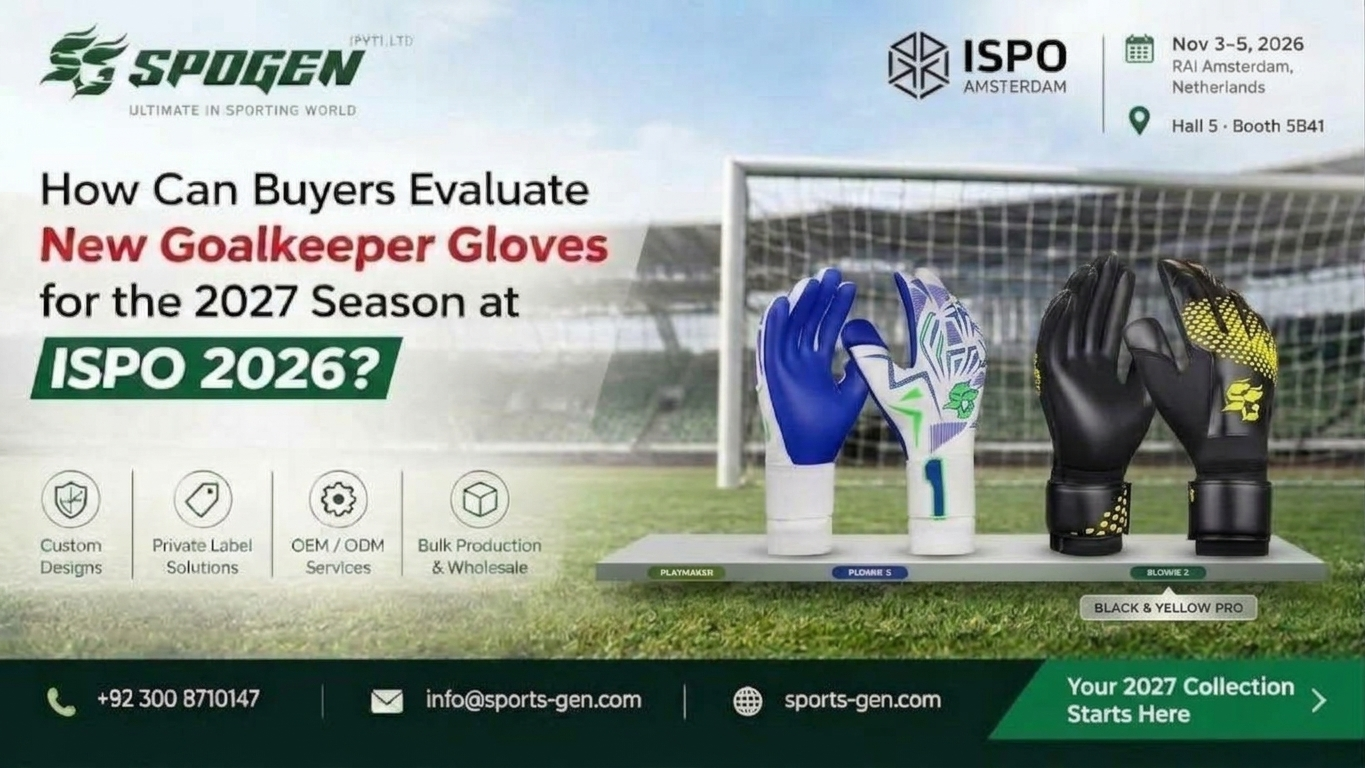
How Can Buyers Evaluate New Goalkeeper Gloves for the 2027 Season at ISPO 2026?
Buyers should evaluate goalkeeper gloves across four areas: performance, construction, customization and supplier capability. A glove can look great on a display table and still fail on grip, fit or repeat production. That is why a first look should never be the final decision.
ISPO 2026 takes place at RAI Amsterdam. The ISPO Leaders’ Summit is on November 3 and the main exhibition runs on November 4–5, 2026. For buyers, the event is a chance to research products and suppliers for future collections in one place.
If you are planning goalkeeper gloves for 2027, start with a clear evaluation process. Judge the glove as a product. Then judge the supplier behind it. A strong sample means little if the factory cannot make the same glove again in bulk.
This guide shows what to check, what to ask and how to move from a meeting at the Amsterdam show to a 2027 sample.
Why Are Buyers Looking at 2027 Goalkeeper Gloves at ISPO 2026?
Buyers look at 2027 goalkeeper gloves now because product planning often starts months before a season begins. Late 2026 is a practical time to research designs, talk to manufacturers and decide what to sample.
A trade show also saves time. In one visit, a buyer can handle several gloves, compare finishes, and speak with factory teams face to face. It also shows how different makers handle cuts, closures and colors, which helps buyers write a clearer product brief before they ask for samples.
What Should Buyers Check First When Evaluating a New Goalkeeper Glove?
Buyers should check grip, fit, construction, and materials first. Branding and color come after these basics.
1. Palm Latex and Grip
The palm touches the ball, so it deserves the most attention. Test how the latex grips a ball when it is dry and when it is slightly damp.
Softer latex often feels stickier but may wear faster. Firmer latex may last longer but feel different on the ball. The right balance depends on the target goalkeeper, the price level and the playing conditions. Ask what latex and foam backing are used in each sample.
2. Glove Cut and Fit
The cut is the way the palm and fingers are built. Common cuts include flat, roll, negative and hybrid. Each one gives a different fit.
The glove should feel snug without squeezing the fingers. Check that sizes feel consistent from one to the next and ask for the size chart and pattern details.
3. Backhand Construction
The backhand protects the hand and often carries the design. Check the materials, how the layers are joined, and whether the edges are clean. Press and bend it. It should return to shape and should not peel or bubble. Also think about breathability, since a glove that traps heat feels poor in long sessions.
4. Finger Protection and Flexibility
Some gloves have built-in finger support and some do not. The right choice depends on your market and your goalkeepers. Ask whether protection can be added or left out. Either way, the fingers should bend freely and not feel stiff.
5. Wrist Closure and Support
The closure keeps the glove on the hand and supports the wrist. Check how the strap or cuff holds and whether it is easy to put on and take off. Look at how the strap is attached, since this area takes a lot of stress.
6. Stitching and Construction Quality
Look for straight, even stitches, clean edges and no loose threads. Check the fourchettes, which are the pieces between the fingers, since weak points often show up there first. Small flaws that repeat across pairs are a warning sign for bulk production.
7. Materials and Overall Comfort
Ask for a material list for each sample. Then hold the glove for a few minutes. Is it light and soft on the skin? Comfort matters because players notice it every time they wear the glove.
8. Design and Branding Potential
Look at where your logo can go, such as the backhand, strap or cuff. Ask which branding methods are possible, such as screen printing or embossing and how they hold up after use. Check that colors match from pair to pair.
How Can Buyers Compare Goalkeeper Glove Samples at ISPO 2026?
The best way to compare samples is to use the same checklist for every glove. This keeps the decision fair and makes your notes useful when you are back at your desk.
Label each sample with the supplier name and product code, take photos, and score each feature from 1 to 5.
| Feature | What to Check | Why It Matters |
|---|---|---|
| Palm latex and grip | Feel, softness, grip on a dry and damp ball | It affects performance and how long the glove lasts |
| Cut and fit | Cut type, finger length, size chart, size consistency | A poor fit leads to returns and weak reviews |
| Backhand | Layers, edges, breathability, shape after bending | It affects comfort and the look of the glove |
| Finger protection | Support type, flexibility, option to remove | It must match the target goalkeeper and market |
| Closure and wrist | Strap grip, ease of use, strength of attachment | The glove must stay secure during play |
| Stitching | Seam lines, loose threads, fourchette finish | It shows build quality and repeatability |
| Materials | Lining, foam, mesh, material list | It affects comfort and durability |
| Branding | Logo areas, methods, color match | It decides how well your brand shows up |
| Packaging | Box or bag type, labels, protection | It is the first thing your customer sees |
Ask each supplier the same questions too. If one answer is clear and another is vague, that tells you something useful. If you are planning to visit ISPO 2026 in Amsterdam, a live countdown timer can make your preparation easier. Instead of simply showing how many days are left, use the countdown as a reminder to complete your buyer checklist before the event.
For example, before the timer reaches zero, buyers can:
- Prepare their 2027 goalkeeper glove requirements
- Decide which glove features matter most to their target market
- Create a simple 1–5 sample scoring sheet
- Prepare questions about latex, cuts, finger protection, stitching, branding and MOQ
- Save photos and product codes of samples they want to compare
- Book meetings with shortlisted suppliers before arriving at the show
What Questions Should Buyers Ask a Goalkeeper Glove Manufacturer?
Buyers should ask questions that cover the product, the process and the paperwork. Clear answers show that a supplier understands its own production.
- Materials: Which latex, foam, mesh and strap materials are used? Can we see a material list?
- Construction: Which cuts can you make? Can finger protection be added or removed?
- Customization: What can we change, such as colors, logo, closure or backhand design?
- MOQ: What is the minimum order per design, size and color?
- Sampling: How many samples can we request and how long does sampling take?
- Lead time: How long does bulk production take after sample approval?
- Production: How are orders planned and how is the approved sample kept as the reference?
- Quality control: What checks happen during and after production?
- Packaging: Can you make custom packaging, labels and hang tags?
- Branding: Which logo methods do you use and how do you test their durability?
- Compliance: Which certificates and documents can you provide?
- Shipping: What packing, shipping and delivery options are available?
Write the answers down. Spoken answers are easy to forget after a busy show day.
How Should Private-Label Buyers Evaluate Goalkeeper Glove Suppliers?
Private-label buyers should confirm five things before bulk production: what the glove is made of, how the brand will be applied, how samples are approved, how packaging is handled, and how the supplier keeps bulk orders the same as the approved sample.
- Branding and logo application: Ask for a sample with your logo in place.
- Colorways: Confirm how colors are matched and approved.
- Packaging: Confirm the design, labels and carton marking.
- Specifications: Get a written spec sheet for every design.
- Sample approval: Agree on one signed-off sample as the reference.
- Consistency: Ask how the factory keeps pairs the same across a large order.
- Communication: Choose a supplier that replies clearly and on time.
- Bulk manufacturing: Confirm order planning and how changes are handled.
Private-label readiness also means the supplier can follow your brand rules, such as logo size and color codes. A short brand guide helps.
Why Sample Evaluation Matters Before a 2027 Bulk Order
A sample shows what a supplier can actually make. It lets you test grip, fit and finish before you commit to production. Changes made at sample stage are faster and cheaper than fixes after bulk goods are made.
An approved sample also becomes the reference for the whole order. The factory has a standard to match, and you have a standard to check against when the goods arrive.
Do not rush this step. A sample that is almost right often becomes a bigger problem in bulk.
How Can Buyers Compare Manufacturers, Not Just Gloves?
The best-looking sample is not automatically the best supplier. A beautiful sample may be a one-off. Buyers need a supplier that can make the same glove again and again.
Compare these areas:
- Product quality across several pairs, not just one
- Manufacturing experience with goalkeeper gloves
- Communication that is clear, quick, and honest
- Customization capability
- The sampling process, including how many rounds it takes
- Quality control steps
- Production planning
- Delivery expectations
- Documentation
- Ability to reproduce approved samples consistently
Ask to see more than one pair. Then ask how the supplier would handle a change, such as a new color or logo position.
What Should Buyers Take to a Goalkeeper Glove Supplier Meeting at ISPO 2026?
A short brief makes every supplier meeting more useful. Bring:
- Target product type
- Target market
- Estimated quantity
- Preferred materials
- Palm preference
- Glove cut
- Finger protection requirement
- Size range
- Color preferences
- Branding requirements
- Packaging requirements
- Target launch season
- Target delivery timeline
- Required certifications or compliance documents
- Sample requirements
If you do not know every item, bring what you have and ask the supplier to help fill the gaps. Also bring a notepad, a phone for photos and a copy of your comparison table.
Planning goalkeeper gloves for your 2027 collection? Book your meeting in advance and meet Spogen at Hall 5, Booth 5B41 to discuss custom designs, private-label requirements, samples and bulk production.
How Can Buyers Start Developing a 2027 Goalkeeper Glove After ISPO 2026?
A realistic workflow moves from idea to bulk order in clear steps. Exact timing depends on the design and the supplier.
- Discuss the product concept.
- Share your requirements.
- Confirm the specifications.
- Develop the sample.
- Review the sample.
- Request modifications.
- Approve the final sample.
- Confirm commercial terms.
- Begin bulk production.
- Conduct quality control.
- Prepare shipment.
Confirm each step in writing. Spogen agrees sample and production timelines with each buyer based on the design.
Why Consider a Sialkot Manufacturer for 2027 Goalkeeper Gloves?
Sialkot, Pakistan, is a long-established sports goods manufacturing hub, especially known for football production. Many sports equipment makers work in the city, so skills and supply networks are close at hand.
Spogen Pvt Ltd is a B2B sports goods manufacturer based in Sialkot. The company makes goalkeeper gloves, soccer balls, sports apparel, sports bags, and team uniforms for wholesale buyers, importers, distributors, retailers, clubs, academies, and private label brands. Spogen is BSCI, ISO 9001 and ISO 14001 certified.
Buyers can learn more about custom goalkeeper gloves on the Spogen website. Spogen works with buyers on OEM, ODM and private-label projects. Details such as MOQ, sample time and production capacity for gloves are confirmed directly with each buyer.
What Should Buyers Do After Meeting a Goalkeeper Glove Manufacturer at ISPO 2026?
The days after the show matter as much as the meeting itself. Use this list:
- Write up your notes on the same day.
- Sort your sample photos and scores.
- Send each supplier a clear written brief within a few days.
- Request samples and the documents you need, such as compliance papers.
- Shortlist two or three suppliers.
- Compare samples, communication, and terms side by side.
- Request a quotation once the specifications are confirmed.
- Plan the timeline backward from your launch date.
Final Checklist: Evaluating Goalkeeper Gloves for the 2027 Season
- Grip, fit and construction tested on every sample
- Size chart and material list received
- Finger protection and closure options confirmed
- Branding methods and packaging reviewed
- MOQ, sampling and lead time noted
- Quality control process explained
- Compliance documents requested
- Samples labeled and photographed
- Next steps agreed in writing
Frequently Asked Questions
Check palm grip, cut and fit, backhand construction, finger protection, closure, stitching, materials, and branding. Also check whether the supplier can repeat the same quality in bulk.
Use one checklist and one scoring scale for every sample. Label each glove, take photos, and ask every supplier the same questions.
Ask about materials, logo methods, colorways, packaging, MOQ, sampling, lead time and quality control. Also ask how the approved sample is kept as the production reference.
A sample sets the standard for the full order. Fixing problems at sample stage is faster and cheaper than fixing them in bulk.
Bring your target product, market, quantity, materials, cut, sizes, colors, branding and packaging needs, launch season, delivery timeline, and compliance requirements.
Yes, many manufacturers offer customization such as colors, logos, and packaging. The options depend on the supplier and the design, so confirm them before requesting samples.
Judge both the gloves and the supplier. Compare sample quality, communication, customization ability, quality control, and the ability to reproduce approved samples.
Buyers planning a 2027 goalkeeper glove collection can discuss their product requirements with Spogen’s team at ISPO 2026 or submit their requirements online for further discussion.
Conclusion
Choosing goalkeeper gloves for the 2027 season is about more than design. Buyers should evaluate grip, fit, construction, customization, sample quality and supplier capability before making a decision.
ISPO 2026 gives buyers an opportunity to compare gloves, meet manufacturers and discuss their future product requirements in person. A clear evaluation process can help turn an ISPO meeting into a stronger sample and, ultimately, a reliable 2027 product collection.
If you are planning custom or private-label goalkeeper gloves for 2027, get a free B2B Quote to discuss your requirements.