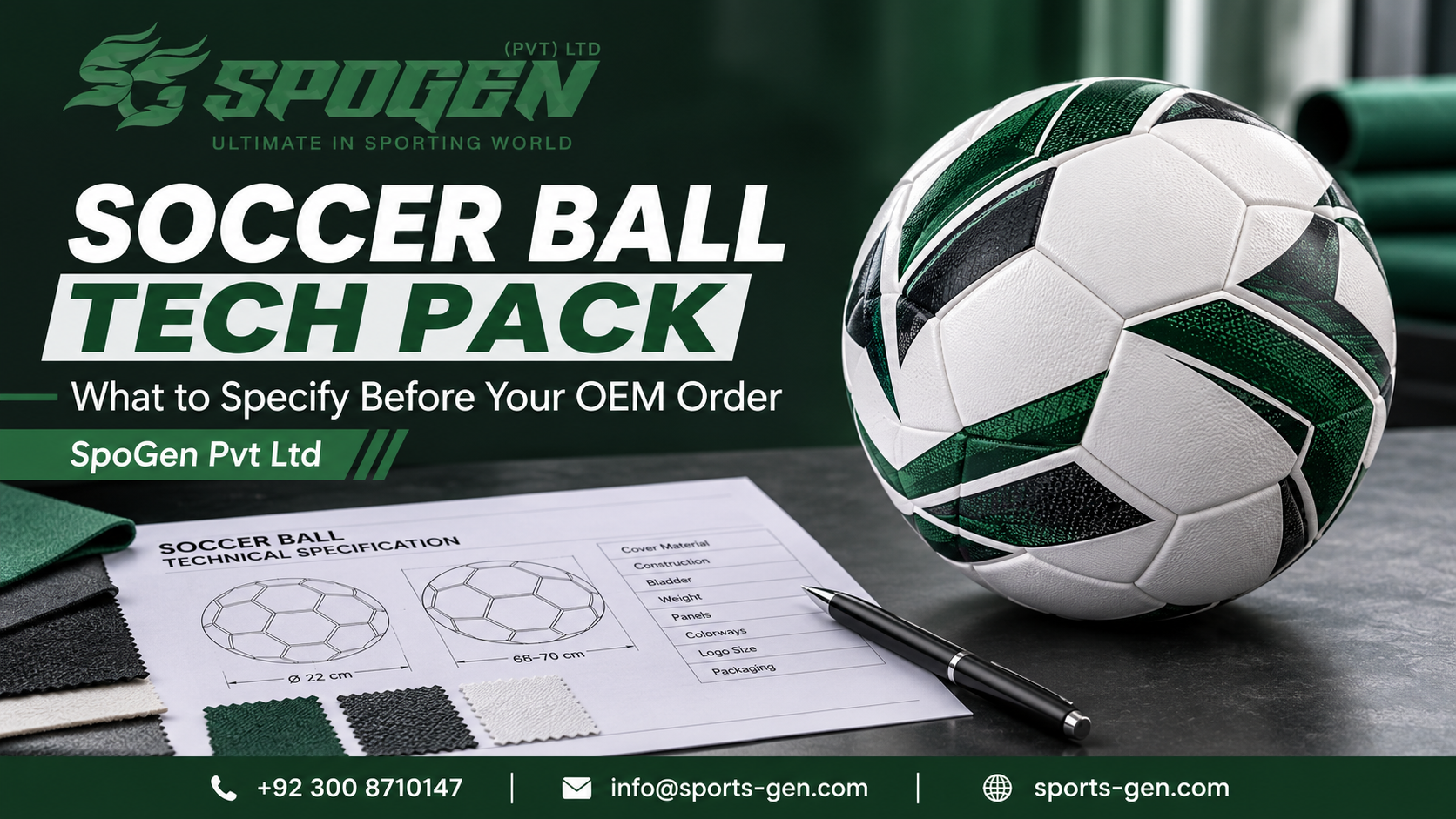
Soccer Ball Tech Pack | What to Specify Before Your OEM Order
A soccer ball tech pack is the document you give a manufacturer, so they know exactly what ball to quote, sample and produce. It covers the ball’s size and use, cover and bladder, construction, panels and artwork, logo placement, performance targets, packaging and how you will approve samples. You do not need a perfect tech pack to start. But the more you define, the more accurate your quotation and the fewer sample rounds you need.
Many first-time buyers begin with a photo and a sentence: “Make a ball like this, with our logo.” That is a fine start. But a photo does not show the cover material, the bladder, the construction or the target weight. Each missing detail becomes a guess, and guesses show up later as a sample that misses or a price that changes.
This guide shows what to prepare, why each detail matters and what to do if you are not ready yet. For the factory side, see our soccer ball manufacturing process. This article is about what you prepare.
Table of Contents
What Is a Soccer Ball Tech Pack?
A tech pack is a document that defines your ball in writing and in pictures. It usually includes the specification table, artwork files, a panel layout, logo positions, performance targets, packaging details, and the sample approval steps.
Tech pack vs. specification sheet: A specification sheet lists the technical details. A tech pack is bigger. It adds drawings, artwork, approval rules and a revision history. Many buyers use the two words for the same thing, and that is fine. What matters is that the information is written down and version controlled.
It is also not a quotation request. A quotation request asks “how much?” A tech pack answers “what exactly?” Giving both together is what leads to a quotation you can trust.
Why a Tech Pack Matters Before OEM Production
- A more accurate quotation: Cover material, bladder, construction, print and packaging all change the cost. Missing details force the manufacturer to assume.
- Fewer sample rounds. Clear specs get the first sample closer to what you want.
- Bulk that matches the sample: The approved sample and the tech pack become the reference for production.
- Fewer disagreements: If something is wrong, you can both compare it with what was agreed in writing.
What Information Should You Send a Soccer Ball Manufacturer for an OEM Quote?
You do not need to know every technical detail before you make contact. The manufacturer can review your first brief and tell you what is missing. But some information changes the price directly. Missing items may change the quotation later.
| Information | Why the manufacturer needs it |
|---|---|
| Ball size and intended use | Match, training, promotional and youth balls are built differently |
| Material and construction preferences | These set the cost and the feel of the ball |
| Estimated order quantity | Quantity affects planning and pricing |
| Number of designs and colour variations | More designs mean more artwork setup and separate production runs |
| Branding and artwork requirements | Printing, embossing and logo size affect time and cost |
| Packaging requirements | Individual bags, boxes and carton packing change cost and shipping volume |
| Target market or destination country | It can affect labelling and compliance needs |
| Expected delivery window, if known | It helps the factory check whether the plan is realistic |
Technical specification vs. commercial details. The technical specification describes the ball. The commercial details (quantity, designs, destination, delivery window) describe the order. You need both for a real quotation.
What to Include in a Soccer Ball Tech Pack
Not every item is needed for every ball. A promotional ball needs fewer details than a branded match-style ball. Choose what fits your product, market and performance needs. The table shows what to specify, why the factory needs it and what can go wrong.
| Specification | Why the factory needs it | If missing or unclear |
|---|---|---|
| Size and intended use | Sets the pattern, weight range and build | Wrong size or wrong feel for the use |
| Cover material (and thickness or grade, if known) | Drives durability, touch and cost | A sample that feels different from your reference |
| Backing and lining layers | Affect shape, bounce and feel | Ball loses shape or feels hard or soft |
| Bladder material | Affects air retention and bounce | Balls go soft quickly or bounce differently |
| Valve type | Affects inflation and air loss | Leaks, hard inflation, wrong needle fit |
| Construction method | Sets look, durability and cost | Price changes after quoting |
| Panel count and layout | Defines pattern and artwork area | Artwork does not fit the panels |
| Artwork and Pantone colours | Used for printing and colour matching | Colour mismatch or low-quality print |
| Logo position and size | Defines where and how big | Logos placed differently from your plan |
| Weight, circumference, inflation pressure | Define how the ball must measure | Disagreement about whether a ball is “correct” |
| Packaging and carton details | Affect shipping and retail readiness | Wrong packing, extra costs, delays |
Cover, backing and bladder in simple terms
- PU, TPU and PVC are common synthetic cover materials. Their feel, durability and cost differ by grade and thickness, so name the grade and ask for a swatch rather than relying on the material name alone.
- Backing and lining are the layers under the cover. They affect shape retention and how the ball feels when kicked.
- Latex and butyl bladders are the two common types. Latex is often chosen for feel. Butyl is often chosen for better air retention. The right choice depends on your product and market.
Construction method
Name the method: hand-stitched, machine-stitched, thermally bonded or a hybrid. Each affects the look, durability and cost. For how they are made, see our seamless and thermo bonded ball page.
Panels, artwork and logo
- Ask the factory for a panel template and design on it, not on a flat picture of a ball.
- Send vector artwork (AI, EPS or outlined PDF), plus Pantone codes.
- Show logo position and size with a drawing, including distance from seams and the valve.
- Ask about printing limits: fine lines, small text and large solid colours do not behave the same on every cover.
- Plan for a physical colour approval. Screen colours and printed colours often differ.
Packaging, labels and shipping
Specify the packing type (bag, mesh bag or box), barcode needs, label text, carton size, balls per carton and whether balls ship inflated or deflated. Ask your compliance contact which rules apply in your destination market, and write the answer into the tech pack.
Performance Requirements: Targets, Tolerances and Test Methods
Listing a test name is not enough. For each requirement, agree on five things:
- Target value: what you want.
- Tolerance: how far from the target is acceptable.
- Test method: how it will be measured.
- Who tests: you, the factory or a third party.
- Sample size: how many balls are checked.
It also helps to separate three ideas:
| Term | Meaning | Example |
|---|---|---|
| Product specification | What the ball is | Cover, bladder, construction |
| Target performance | What the ball should do | Holds air, keeps shape |
| Acceptance criteria | When a ball passes or fails | Agreed range, test method, sample size |
Do not copy one standard for every ball: Match balls, training balls, promotional balls, youth balls and futsal balls can have different requirements. As a reference, the Laws of the Game set a circumference of 68 to 70 cm and a weight of 410 to 450 g for a standard match ball. Futsal has its own figures. For training, youth or promotional balls, set your own targets for your use.
Commonly checked areas include weight, circumference, roundness, bounce, water absorption, air pressure loss, and shape and size retention. State the inflation pressure you want in the tech pack, and write down your tolerance for each item.
Competition rules or quality marks: If your product must meet a competition’s rules or carry a quality mark, write the required standard or certification in the tech pack and raise it early. That approval is a separate path from normal production.
What Should You Check Before Approving a Soccer Ball Sample?
Approve a sample against your tech pack, not just by feel.
| Check | What to look at |
|---|---|
| Appearance and finish | Surface, texture, glue marks, scratches |
| Panel alignment | Panel edges, seam lines, pattern match |
| Colour accuracy | Compare with your Pantone codes or a physical swatch |
| Logo placement | Position and size against your drawing |
| Print quality | Sharp edges, no smudging, good adhesion |
| Dimensions and weight | Measure against your targets |
| Bladder and valve | Inflation feel, valve position, leaks |
| Air retention | Check pressure after the agreed time |
| Agreed performance requirements | Your targets, tolerances and test method |
| Packaging and labels | Text, barcode, carton details |
How to give feedback: write it down, mark each point as “approved” or “change”, attach photos and use a version number. Do not send changes only by chat message.
Approve one reference sample: Before bulk production, agree on one final approved sample. Both sides should keep one reference, and production should be checked against it. If you want to change anything after approval, issue a new tech pack version and confirm the effect on price and timing.
Buyer and Manufacturer Responsibilities
| Step | Buyer | Manufacturer |
|---|---|---|
| Provide product brief, artwork and targets | ✔ | |
| Review the brief for feasibility | ✔ | |
| Point out missing or risky specifications | ✔ | |
| Prepare the quotation | ✔ | |
| Develop the sample | ✔ | |
| Review and approve the sample | ✔ | |
| Agree quality requirements and test methods | ✔ | ✔ |
| Control bulk production against the approved sample | ✔ | |
| Confirm any change in writing | ✔ | ✔ |
Agree on these responsibilities before production starts.
What Happens After You Send Your Tech Pack?
- The manufacturer reviews your tech pack and asks questions.
- They tell you what is feasible and what needs to change.
- You receive a quotation.
- A development sample is made.
- You check it and send written feedback.
- You approve a final reference sample.
- Bulk production follows the approved sample.
- Inspection takes place before shipment.
Example Soccer Ball Tech Pack (Illustrative Only)
This is an example of how a buyer might fill in a tech pack. It is not Spogen’s standard specification and it does not mean SpoGen makes every configuration.
| Field | Illustrative entry |
|---|---|
| Product name and ID | Club Trainer X, ref. CT-001 |
| Version and date | v1.0, [date] |
| Size and intended use | Size 5, club training |
| Outer material | PU, matte finish |
| Thickness | [To be confirmed with factory] |
| Backing and lining | [Buyer preference or “factory to advise”] |
| Bladder and valve | Butyl, standard valve |
| Construction | Thermally bonded |
| Panel layout | 12 panels, factory template |
| Artwork | Vector file, Pantone 361 C and 296 C, white |
| Logo placement | Two panels, 40 mm wide, centred |
| Weight and circumference | Buyer’s target range [define] |
| Inflation pressure | Buyer’s target [define] |
| Quality requirements | Agreed inspection level, test list and sample size |
| Packaging | Individual polybag, 20 balls per carton, shipped deflated |
| Sample approval status | Development sample requested |
Common Specification Problems
These are common in custom ball projects. They are general examples, not documented Spogen cases.
- Panel artwork is missing, or sent on a flat sketch instead of a template.
- Logo position is unclear (which panel, how big, how far from the valve).
- Material details are incomplete, for example “PU” with no feel reference.
- The print design depends on detail the cover cannot hold.
- Performance targets are vague, such as “good quality.”
- The specification changes after the sample was approved, with no new version.
No Tech Pack Yet? Start Here
You can begin with what you have:
- a reference ball or photos
- the size and intended use
- a design idea or rough sketch
- logo or artwork files, if available
- an approximate order quantity
- your target market
- packaging preferences
FAQs about Soccer Ball Tech Pack
It is a document that defines the ball you want made: size, materials, bladder, construction, artwork, performance targets, packaging and sample approval steps.
A specification sheet lists technical details. A tech pack also includes drawings, artwork, approval rules and revision history. Many people use the terms for the same thing.
Not always. But it helps you get a more accurate quotation and a clear reference for sampling and bulk production. If you do not have one, send a brief.
Size and use, material and construction preferences, estimated quantity, number of designs and colours, branding needs, packaging, target market and delivery window, if known.
A spec document or spreadsheet, vector artwork (AI, EPS or outlined PDF), Pantone codes, a logo placement drawing and any reference photos.
Yes, you can start with a brief and reference. Missing details may need to be agreed before the final quotation, and they can affect price or timing.
Cover material, backing, bladder, construction method, number of designs, print method, packaging and order quantity. Quality and testing requirements can also affect cost.
Check it against your tech pack, record feedback in writing, and approve one final reference sample. Both sides should use it for bulk production.
It depends on how close the first sample is. Clear specifications often mean fewer rounds. Confirm the sample process with Spogen.
Start Your Custom Soccer Ball Project with Spogen
You don’t need a complete tech pack to get started. Share your ball design, preferred size, intended use, estimated order quantity and any available references.
As a factory-direct B2B sports goods manufacturer in Sialkot, Pakistan, Spogen works with brands, importers, wholesalers, distributors, and sports businesses on OEM, ODM, and private-label manufacturing requirements. Our team will review your brief, discuss technical requirements, and help you understand the next steps towards sampling and bulk production.
Have a Soccer Ball Project in Mind?