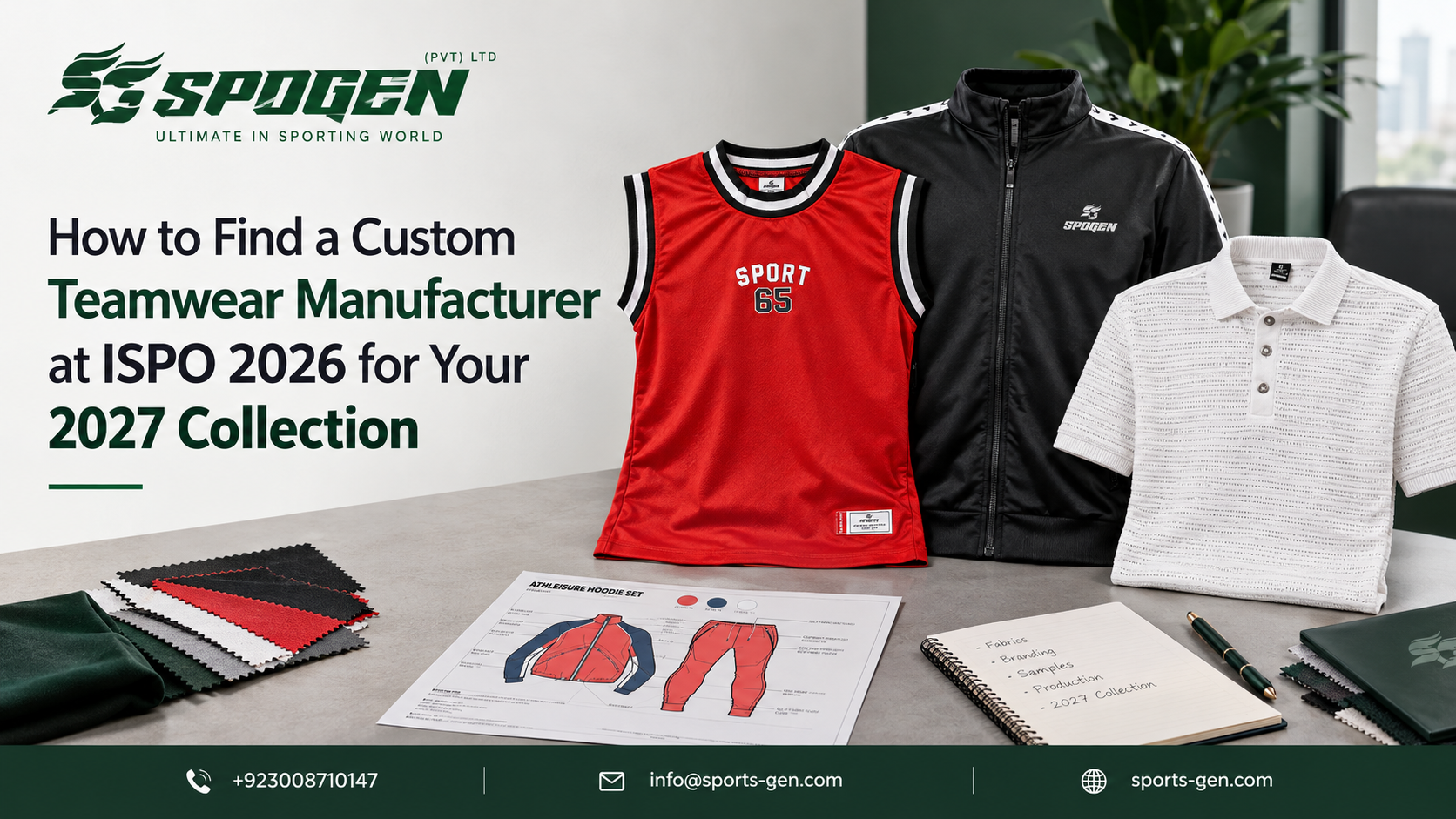
How to Find a Custom Teamwear Manufacturer at ISPO 2026 for Your 2027 Collection
Finding the right custom teamwear manufacturer is an important step when planning a new sportswear collection. For sports brands, clubs, importers and wholesalers, the right partner can help turn an idea into a well-made product that meets customer needs.
ISPO Amsterdam 2026 offers an opportunity to meet sports industry suppliers, discuss manufacturing options and prepare for future product development. ISPO’s official information lists the expo for 4–5 November 2026 at RAI Amsterdam. Read the official ISPO event information.
For businesses planning a 2027 collection, the goal should be more than collecting supplier contacts. You need to understand how a manufacturer works, what it can produce, how it checks quality and whether it can meet your product requirements.
Spogen Pvt Ltd, a B2B sports goods manufacturer based in Sialkot, Pakistan, works with custom sportswear, teamwear and private-label sports products. At ISPO, buyers can use a meeting with Spogen to discuss their ideas, product requirements and possible next steps for the upcoming collection.
This guide explains how to prepare, what to ask and how to assess a potential manufacturing partner before moving towards a 2027 launch.
Define Your Teamwear Requirements Before ISPO 2026
Before meeting a manufacturer, decide what you want to develop. A clear brief saves time and helps suppliers give more useful answers.
For example, a football club may need match jerseys, shorts and training shirts. A sportswear brand may want to develop a new range for retailers. A distributor may need several teamwear styles in different sizes and colours.
Write down your basic requirements before the event.
- Product type: Match jerseys, training shirts, shorts, tracksuits or complete team kits.
- Target customer: Professional clubs, amateur teams, schools, academies or retail customers.
- Target market: The countries where you plan to sell the products.
- Design: Your preferred colours, logo placement, fit and style.
- Materials: Your preferred fabric type, weight, stretch and comfort requirements, if known.
- Order quantity: Your estimated quantity per style, colour and size.
- Budget: Your target cost per item and expected selling price.
- Timing: When samples must be approved and when the finished goods need to be ready.
You do not need to know every technical detail before the first meeting. A good manufacturer should be able to discuss your needs and explain which details must be decided before sampling.
Why does a clear product brief matter?
Imagine that two suppliers quote for the same football jersey. One quote includes custom sublimation printing, while the other includes a different printing method. Their prices may not be directly comparable.
A clear brief helps you compare the same product requirements, rather than choosing a supplier based on price alone.
Check the Manufacturer’s Teamwear Experience
Not every sports goods supplier has the same skills. Some focus on finished products, while others support custom product development and private-label manufacturing.
When you meet a potential custom teamwear manufacturer at ISPO 2026, ask about its experience with products similar to yours.
Useful questions include:
- Does the manufacturer produce custom teamwear or only supply ready-made garments?
- Can it work from your design, reference sample or technical specification sheet?
- Which fabric and branding options can it support?
- Can it produce the sizes and quantities you require?
- How does it check stitching, print quality, fit and garment measurements?
- Can it explain its sample approval and bulk production process?
Ask to see relevant samples, close-up photographs or manufacturing footage. Look carefully at seams, stitching, print edges, fabric appearance and finishing. A polished sample is useful, but it is not enough on its own. You should also understand how the manufacturer plans to reproduce the approved quality across the full order.
What is OEM and ODM teamwear manufacturing?
OEM manufacturing means a manufacturer produces goods according to the buyer’s specifications. For example, a sports brand may provide its own jersey design, logo, colours and measurements.
ODM manufacturing means a manufacturer offers product designs or development options that the buyer can adapt or use under an agreed arrangement.
Private-label manufacturing means products are made for sale under the buyer’s brand. The exact level of design ownership, customization and responsibility depends on the agreement.
Before choosing a partner, confirm which services it actually offers. Do not assume that every manufacturer can provide every type of customization.
Compare Fabric, Stitching and Printing Before Choosing
A teamwear product must look good, feel comfortable and suit the activity for which it is designed. Its fabric and construction can affect comfort, appearance, durability and cost.
Use your ISPO meeting to discuss these details with potential manufacturers.
Fabric selection
Ask the manufacturer to explain the available fabrics and their intended uses. Depending on the product and supplier’s capabilities, options may include polyester-based performance fabrics, stretch materials or different fabric weights.
For training shirts, you may want to discuss moisture management, breathability and freedom of movement. For tracksuits, the focus may be on warmth, fit and everyday use.
Do not choose fabric based only on a product description. Request a swatch or sample when possible, then check its feel, weight, stretch and appearance.
Stitching and construction
Inspect the seams, hems, collars and other areas that may experience repeated movement or washing.
Ask how the factory checks garment measurements and stitching quality. For a large order, also ask how it handles defects and keeps production consistent.
Printing and branding
Custom teamwear can use different branding methods. Sublimation printing, for example, uses heat to transfer dye into suitable synthetic fabric. Other methods may be more appropriate depending on the garment, design and material.
Discuss the colours, logo placement, artwork quality and expected finish. Ask whether the chosen method suits the fabric and how the manufacturer checks the finished print.
If you need embroidered logos, heat transfers or other decoration, confirm availability for your specific product rather than assuming every option is supported.
Buyer tip: Compare samples against the same requirements. A lower-priced jersey may not offer the same fabric, fit, branding or construction as a more expensive option.
Understand the Sample Approval Process
Sampling is one of the most important steps when developing a custom teamwear collection.
A sample lets you review the product before committing to bulk production. It helps you identify problems early and gives both parties a clear reference for the agreed design.
A typical development process may include:
- Share your brief: Provide the design, target quantity, sizes, materials and branding requirements.
- Review the proposal: Discuss technical details, material choices, costs and any limitations.
- Develop the sample: The manufacturer prepares a sample based on the agreed specifications.
- Test and review: Check fit, measurements, comfort, seams, printing and finishing.
- Request changes: Explain any corrections clearly and agree on whether another sample is required.
- Approve the final version: Confirm the final specifications and approved sample before bulk production.
The actual process and timing vary by product, sample complexity and factory workload. Ask for a written timeline instead of relying on a general estimate.
For your 2027 collection, begin discussions early enough to allow for sample changes, costing, order planning and production. The date of your planned launch should guide the development schedule.
Check Quality Control and Production Consistency
One good sample does not guarantee that every item in a large order will match it.
Before selecting a manufacturer, ask how it checks quality during production. For teamwear, useful checks may include garment measurements, stitching, fabric defects, logo position, colour consistency and finishing.
Ask the supplier to explain its actual quality-control process. If it uses written inspection procedures, request details about the checks relevant to your product.
You should also agree on what happens if the delivered goods do not meet the approved specifications. This should be discussed before placing an order, not after a problem occurs.
Questions to ask about quality
- Is there an approved sample or specification sheet for reference?
- Who checks the garments during and after production?
- How are size and measurement differences handled?
- How are printing and colour consistency checked?
- What happens if defects are found?
- Can the agreed inspection requirements be documented in writing?
Ask for evidence where appropriate. Factory photographs, inspection records and clear product specifications can help you evaluate a supplier more confidently.
Certifications can also be relevant, but check their scope, validity and issuing body. A certification should not be treated as proof that every individual product meets your requirements.
Compare Quotations, Minimum Orders and Delivery Timelines
Price matters, but the cheapest quotation is not always the best value.
When comparing custom teamwear manufacturers, check whether the quotations cover the same specifications. Differences in fabric, printing, packaging, order quantity or shipping terms can make a major difference to the final cost.
Request a written quotation that explains:
- Price per item and the currency used.
- Minimum order quantity, if applicable.
- Sample charges and development costs.
- Custom branding and packaging charges.
- Payment terms.
- Production lead time after the required approvals.
- Shipping arrangements and delivery terms.
- Any agreed quality inspection requirements.
Ask whether the minimum order quantity applies to each design, colour, size or total order. This can affect how you plan a collection with several product variations.
Also separate production time from total delivery time. Material sourcing, sample revisions, approval delays, packing and international transport can all affect your launch schedule.
For a 2027 launch, agree on realistic dates and identify which approvals your business must complete to keep the project moving.
Use ISPO 2026 to Prepare Your 2027 Collection
ISPO Amsterdam can be a useful place to meet manufacturers, compare product ideas and begin conversations about future collections. The official event information lists the ISPO Expo for 4–5 November 2026 at RAI Amsterdam. Check the official event website for the latest visitor and exhibitor details before travelling.
For buyers planning a 2027 range, use meetings to explore product possibilities without expecting every design to be finalized during the event. You can bring fabric references, existing garments, sketches, logo files and a list of product requirements. These materials help a manufacturer understand what you want to achieve.
What should you discuss at an ISPO meeting?
Focus on the decisions that will move your project forward:
- Which teamwear products are suitable for your target customers?
- Which material and construction options are available?
- What information is needed to develop a sample?
- Which branding methods suit your designs?
- How will the manufacturer check quality?
- What are the next steps for sampling, quotation and approval?
- What timeline would be realistic for your planned 2027 launch?
Avoid sharing sensitive designs with suppliers before you understand how your information will be handled. Where necessary, discuss confidentiality and intellectual property terms before sending detailed files.
Meet Spogen to discuss your teamwear requirements
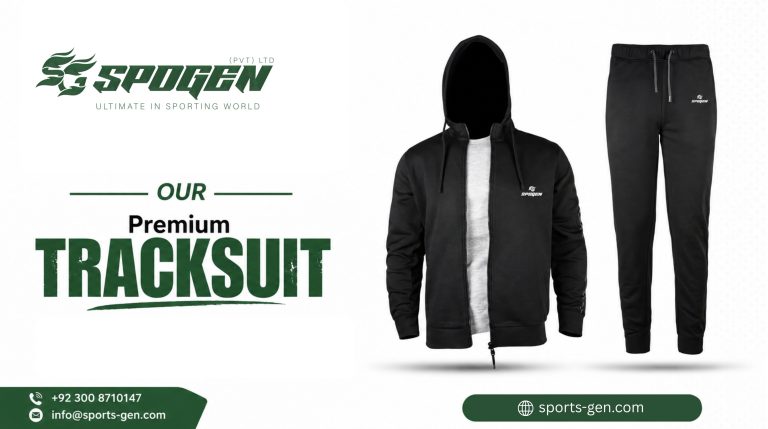
Spogen Pvt Ltd is based in Sialkot, Pakistan, and lists sports apparel, custom teamwear, OEM manufacturing and private-label options among its business offerings. Its manufacturing information describes products such as custom football kits, tracksuits and sports apparel, as well as branding options that include sublimation printing.
You can review Spogen’s sports apparel and manufacturing information before arranging a discussion. At ISPO, use the meeting to explain your target market, preferred product types, estimated quantities and 2027 launch plans. You can also ask which materials, sample options and manufacturing steps are suitable for your specific brief.
Booking early helps you plan your visit and make time for a focused business discussion. Want to meet Spogen at ISPO 2026? Book your meeting in advance with Spogen.
What to Expect from Spogen’s Upcoming 2027 Collection
A new sportswear collection is more than a set of designs. It involves product choices, materials, construction details, branding and decisions about the customers the range should serve.
Spogen’s upcoming 2027 collection creates an opportunity for relevant B2B buyers to begin discussing their requirements ahead of product selection and development.
The focus should be on useful product conversations rather than revealing the full collection before its approved presentation.
Depending on the buyer’s needs and the information approved for sharing, an early discussion may cover:
- Teamwear categories that match the buyer’s business.
- Fabric selection and garment construction requirements.
- Stitching, finishing and branding considerations.
- Sample development and approval steps.
- Private-label requirements and brand placement.
- Estimated order quantities and target delivery dates.
Close-up photographs, approved samples and material swatches can help buyers understand product construction without exposing confidential designs.
For example, a distributor preparing a 2027 football range may want to compare jersey fabrics, logo application methods and sizing requirements. A club may be more interested in matching team colours, player sizes and repeat-order consistency.
These are different business needs, so the conversation should begin with the buyer’s brief.
Important: Specific 2027 product designs, new materials, performance features and finalized specifications should only be described publicly after Spogen approves them for release. Buyers should confirm availability and customization options directly with the company.
A Practical Checklist for Choosing a Teamwear Manufacturer
Use this checklist when comparing suppliers at ISPO 2026 or during follow-up meetings.
| What to check | What to ask for |
|---|---|
| Product experience | Relevant teamwear samples or documented capabilities |
| Materials | Fabric details, swatches and suitable alternatives |
| Customization | Confirmed printing, logo and design options |
| Sampling | Written development steps, costs and timing |
| Quality control | Inspection process and agreed acceptance criteria |
| Pricing | Comparable quotations with clear inclusions |
| Minimum orders | Confirmed quantities for each style and variation |
| Delivery | Production schedule, shipping terms and responsibilities |
| Communication | A clear contact person and documented next steps |
| Trust | Verifiable company details and relevant certification evidence |
After the meeting, record what each supplier confirmed. Ask for written answers to any questions that remain open.
Then compare suppliers against the same requirements. This will help you choose a manufacturing partner based on suitability, quality, communication and commercial terms—not just a promising conversation at the event.
Frequently Asked Questions
Look for a manufacturer with experience in your required products, clear communication and a quality-checking process. Ask to see relevant samples, discuss fabric and printing options, and request written details about pricing, minimum order quantities and delivery times.
Yes. ISPO Amsterdam 2026 is scheduled for 4–5 November 2026 at RAI Amsterdam. Buyers can use the event to discuss product ideas, manufacturing options and plans for future collections. Contact your preferred supplier in advance to ask about meeting availability.
Contact Spogen Pvt Ltd through info@sports-gen.com or visit sports-gen.com to ask about meeting availability. Share your business needs, preferred products and plans for your 2027 collection to help prepare for a useful discussion.
Ask about fabric quality, stitching, printing methods, sample approval, quality control, minimum order quantities, payment terms and delivery timelines. Request a written quotation and confirm that the final product specifications are agreed upon before bulk production.
Spogen lists custom teamwear, sports apparel, OEM manufacturing and private-label options among its business offerings. Contact the company to confirm the products, customization methods and quantities available for your specific requirements.
Start by defining your target customers, product range, budget and launch date. Discuss materials and customization with potential manufacturers, allow time for sample reviews and changes and agree on realistic production and delivery timelines before placing an order.
Conclusion
Finding a custom teamwear manufacturer at ISPO 2026 starts with preparation. Define your product needs, compare relevant samples, ask about materials and quality control, and understand the full process from development to delivery. For businesses planning a 2027 sportswear collection, the event is an opportunity to start practical conversations before committing to a supplier or finalizing an order.
Spogen Pvt Ltd welcomes relevant B2B discussions about custom teamwear, sports apparel, OEM manufacturing and private-label requirements. Prepare your product brief and use your meeting to discuss the options, information and next steps that fit your business.
Planning your 2027 teamwear range? Get a free B2B Quote to discuss your requirements and arrange an ISPO meeting.